Archive: Articles and Writings
May 11, 2008
Pentecost Homily
It can be found here.
Posted by Fr. Jeffrey Keyes, C.PP.S. at 5:27 PM | Comments (1) | TrackBack
May 1, 2008
Novena to the Holy Spirit
Statio, Lectio, Meditatio, Oratio, Comtemplatio
Stop, read, reflect, pray, live differently.
Here are some helps for the nine days beginning Friday.
Posted by Fr. Jeffrey Keyes, C.PP.S. at 9:48 PM | Comments (0) | TrackBack
October 8, 2007
Month of the Holy Rosary
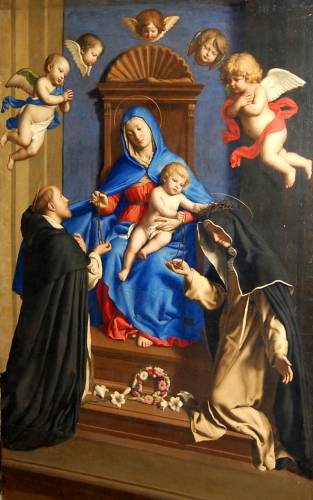
"The traditional image of the Madonna of the Rosary depicts Mary holding the child Jesus in her arm and giving the rosary to St. Dominic. This significant iconography shows that the rosary is a means given by the Virgin for contemplating Jesus and, meditating on his life, for loving and following him always more faithfully." Benedict XVI
The Rosary as a Prayer of Communion
The Rosary is a familiar form of prayer for many Catholics, but it is also a greatly misunderstood prayer as well. Many Non-Catholics believe it is an exercise in mindless repetition or idolatry of Mary. Many Catholics believe that rosary will gain us extra favors or that it can be used as jewelry. Our community has what it refers to as the Precious Blood Rosary as well as what is understood as the more traditional Marian rosary.
The heart of the Rosary is a living relationship with the Lord Jesus and a desire to spend time in his company immersing oneself in the mysteries of his life, death and resurrection. Meditating on these mysteries enables us to remember and to live the heart of the gospel. Knowing these 15 stories, not only with our minds, but with our hearts enables us to walk with Jesus, to pray with him, and to do his will.
The Rosary is essentially a prayer, contemplative prayer. All the emotions of wonder, awe and reverence go with this prayer. All the aims of the ancient practice of Lectio Divina are relevant here. Meditating on the mysteries enables one to “read� the life of Jesus each day. More than reading, meditating on the mysteries in this manner enables one to “chew� the words, to taste them in much the same way as Ezekiel took the scroll on which the Word of God was written and ate it.(1) The use of imagination helps us to enter the story, to hear the voices and to feel the emotions. As the Angel greets Mary in the Annunciation we feel her wonder and doubt. Imagine, the creator of the world being given to you to hold and to care for. Imagine yourself saying “be it done to me according to your word.� Immersing ourselves in the mystery of the Visitation allows us to join in the chorus of “blessed is the fruit of your womb� and to celebrate that “nothing will be impossible for God.�(2)
The praying of the rosary is not about the repetition of many prayers, but a time piece to mark the moment of prayer. Spending time with one another is exactly how a relationship grows and we are drawn into a communion with one another. The prayers we use to mark this prayer experience are fundamentally conversations with the Word of God drawn from the Scripture. The first part of the “Hail Mary� is two passages from the first chapter of Luke’s Gospel. The second part of the “Hail Mary� is the prayer of the church in response. So too, in the rosary we add our own voice, listening to the Word of God and responding from our heart.
The Rosary is an incarnational prayer. The Word was made flesh. In this prayer we use not just mind and heart, but voice and hands as well. In the rosary we are impelled to offer our “bodies as a living sacrifice.�(3) Many of us carry the rosary in our pockets or purses as a reminder, as a tool to carry the prayer with us throughout the day. In this way we follow the command to “pray without ceasing.�(4)
It is through Mary that the Word was made flesh and so in this prayer we also honor the mother of God. She is the one who believed.(5) She is the one who pondered all these things in her heart.(6) She is the one who stood faithfully at the foot of the cross.(7) She is the one given to us to take into our home.(8) For Precious Blood people who remember Gaspars’ devotion to Mary, the Rosary is an important prayer. It is a tool by which we imitate Gaspar who accomplished everything by prayer, we pray with Mary to whom he was so devoted, and we accompany one another in the bond of communion which he so wonderfully preached. Without the correct understanding of Jesus and Mary, without the knowledge of the scripture and the mysteries of the Life of Jesus, the Rosary would be incomprehensible. But with all these things, the Rosary enables us to enter more completely into that intimate communion Jesus established in his own blood.
(1)Ezek 3:3
(2)Luke 1:37
(3)Rom 12:1
(4)1 Thess 5:17, see also Luke 18:1
(5)Luke 1:45
(6)Luke 2:51
(7)John 19:25
(8)John 19:27
Posted by Fr. Jeffrey Keyes, C.PP.S. at 8:48 AM | Comments (6) | TrackBack
July 28, 2007
More on the Madonna of the Precious Blood
Vistors from Don Marco's Blog are invited to find more on this topic here.
Posted by Fr. Jeffrey Keyes, C.PP.S. at 10:40 PM | Comments (0) | TrackBack
July 17, 2007
Lectio Divina
Tonight's Adult Faith Formation class is on Prayer and Lectio Divina.
An important part of any prayer is the act of listening. Certainly when we come to God we ask for what we need and we praise God for his goodness. But we must also come with an openness seeking to listen to his will and to his way. Worship means that we listen to the Master’s voice and respond. The Holy Father in our own day, and even our own spirituality as members of a Precious Blood family call us to listen to the voice of Jesus’ Blood which speaks more eloquently than that of Abel.
The scriptures speak of the Good Shepherd who brings out his flock and goes before them. They follow him because they know his voice. (John 10:1-10) If many of us do not live on farms this image may not speak to us, but if we have ever had a family dog, we know that the sound of our voice is enough to call the pet to our side. This is the kind of listening we need to develop with God.
How do we listen to God? How do we pay attention to his heart, to his way and to his word? The ancients used a practice known as Lectio Divina or Sacred Reading. There are many ways of using this practice down through the centuries and it is described in many ways. Lectio is a reading of the Bible or other sacred texts like the Fathers of the Church or St. Gaspar and Blessed Maria de Mattias in a prolonged contemplative prayer and dialogue. This is different from spiritual reading where one might read several chapters of a spiritual book in one sitting. In Lectio one reads a passage slowly in a way that enables one to “chew� the words, to taste them in much the same way as Ezekiel took the scroll on which the Word of God was written and ate it. (Ezek 3:3) Some find it helpful to read the text aloud and this was very common as an ancient practice. It may take an hour or so to read the Gospel of Mark, but with Lectio it would take several weeks or months.
The first task is to bring yourself, your life and situation to a place of prayer. Prayer is not about a life we imagine we might want to live, but about the life we are living. Then select a passage from a book in the bible or from another of our sacred texts. Read the passage over a few times. Maybe read the passage aloud. Try not to form any response to the text, but listen to what is being said. Go beyond to the text to the person speaking. Now sit for a few moments of silence with what you have heard. What was said? What did God say? Then read the passage again a few more times. This time ask yourself how the passage made you feel. What feelings did these words or this situation provoke in you? Try to avoid thoughts, opinions or judgments but stay with the feelings. What is the heart of Jesus saying? How does my heart respond to his feelings? Then rest for a time in silence with these feelings. Read the passage again a few times. This time ask yourself how God wants you to put his word into action. What is the invitation or the challenge? What must I do to see the Word made flesh in me? Select one concrete action that you can accomplish in the coming day or week. Make sure that it is something you can do, and commit to doing it. Close with a short prayer, maybe the Our Father or another favorite prayer.
Lectio is a reading of God’s word with the eyes and ears of a spouse. It is not a prayer to confirm my own understanding of life. It is a word that desires to break in, to upset my prejudices and lead to a fuller revelation. Lectio is long term activity, not a source of immediate gratification. Lectio is about vocation, the call of God. We are to hear God as he is and not as we want him to be, and we are called to respond. This is a prayer that is to be applied to my own life situation. This time of prayer is supposed to be purposelessness with a sense of gratuity, leisure, and peace. It is about a relationship of love and is not intended to be utilitarian. Reading and praying is not just for the mind. The body must be involved. At the end of the prayer take a passage, a sentence or a word to remember through the day and to bring us back to the encounter.
Because Lectio Divina is dialogue it is therefore reception, self-gift and communion. It is reception by attention and reflection; self-gift through our response; communion through encounter. Our companion on this journey is Mary who kept all these words in her heart.
Posted by Fr. Jeffrey Keyes, C.PP.S. at 11:59 AM | Comments (0) | TrackBack
June 30, 2007
Blood, Sacred Blood
Blessings to all on the Solemnity of the Most Precious Blood.(July 1st) In a world where little is precious or sacred, maybe it is time to reflect on the true freedom given to us in the Most Precious Blood. The following is an old article of mine, basically my homage to St. Gaspar's letter 57. I post it here to move it from my old blog and to make it available for any new readers.
Blood is not pleasant to think about sometimes. Some become squeamish. At the same time, blood has a central place in some of our violent movies and other entertainment. There we do not pay attention to it. It is not real in the movies. Still, spend a few moments thinking about blood, your blood. Stop. Take your pulse. Blood is central. It is powerful. Its action, its force, what it carries, gives us life. It moves faster, we move faster. It fails, we fail. It is the silent, ever present essence of the power of life.
Our ancestors had a vastly simpler, maybe primitive approach to blood. It was simply where life met death and death met life. Fresh, warm, crimson blood was an offering, a sacrifice, a gift back to God, taking the substance of the life God had given and, giving it back, offering it all. We flinch when the priest passes among us on Easter morning scattering the water of the newly blessed font over the people. Can you imagine what it was like in the desert when inaugurating the covenant Moses took half of the blood of the bulls and splashed it on the people? This was before dry cleaning was even imagined. You were stained. It didn’t come out. It was an enduring mark of life. Life branded you, stained you, claimed you as belonging to a covenant with life itself. It was remarkably more than the privileges of membership, and you can’t leave home without it. This primitive approach developed through time to an elaborate ritual in the holy of holies where the blood of sacrifice was placed in the temple’s inner heart on the mercy seat. Blood was a way to communicate with God, to approach the very limits of life and death and receive in return his life and forgiveness.
St. Gaspar would invite us to this same reflection, but then would ask us to spend a few more moments reflecting on God’s blood, divine blood. His letters indicate it is too little to call this blood significant. Somehow our words do not convey its grandeur. This blood was the flaming outburst, the burning expression, the extravagant generosity, of a God of unreasonable and unimaginable kindness. (1) The human body of the Son of God becomes the holy of holies, and now the blood on the mercy seat is the blood rushing through his precious heart. His death on the cross and the tearing of the veil in the temple indicate that the presence of the divine has been snatched from a temple of stone and placed in the temple of a human heart where it is most defeated, overwhelmed or broken. We may think that God has abandoned us in our struggles; yet, in fact, he is closest to the broken and forsaken. You who once were far off have been made near through the Blood of Christ. (2)
This blood has a voice, a piercing cry. For Gaspar the sound of this blood extinguishes any noise of sin. (3) This voice cries out clearly on behalf of sinners and any who are broken. This voice cries to the heavens when life is lost or blood is shed. This is precisely where a devotion to or spirituality of the Precious Blood identifies us. Reciting a devotion is untruthful if it does not correspond to devoted living, and a spirituality is empty if it is not a way of life. A Spirituality of the Precious Blood drives us to follow that voice, to take it up as our own. St. Gaspar would plunge us into these mysteries, (4)bending to its gentle crushing force that urges us on to a courageous love, first for the ineffable love of God, and in the same beat of the heart, to a love for all people, especially those who are far off. Yes, blood can be messy, but it is sacred too.
NOTES
1. Letter 57
2. Eph. 2:13
3. Letter 52
4. Letter 57
Posted by Fr. Jeffrey Keyes, C.PP.S. at 1:25 PM | Comments (0) | TrackBack
December 4, 2006
Advent
A few years ago I found this wonderful little article about Advent on the EWTN website. It had a vague familiar ring to it, and then I saw that I had written it. The address and phone number they have for me is not correct and the whole Sonnino Mission House ideal was given up long ago.
Posted by Fr. Jeffrey Keyes, C.PP.S. at 2:36 PM | Comments (2) | TrackBack
October 17, 2006
St. Ignatius of Antioch
This is an article written previously for Precious Blood Family
The spirituality of the Precious Blood was not new with St. Gaspar in the early Nineteenth Century. He himself was the one who told us that this "devotion of ours is so antique" (1) it goes back to the very beginning. He was to assert that this devotion is "the basis, the sustenance, the essence"(2) of all other devotions. Thus we consider other saints as part of the Precious Blood Family.
This month we consider the life and witness of St. Ignatius of Antioch. He was a Syrian, a convert from paganism, and was the third bishop of Antioch. He was one of those who came to believe through the powerful preaching and example of the Christian community in Antioch, an important community in the spread of the gospel outside of Palestine. It was in Antioch that the believers were first called “Christians." Antioch was one of the first communities to integrate people who had no acquaintance with Judaism. Antioch, as a young church, knew that part of the call was to send out missionaries. They are the ones who commissioned Barnabas and Paul as missionaries. One source indicates Ignatius may have taken over the Church in Antioch around the year 69.(3) Another source states it was during the reign of Emperor Trajan (AD 98-117) that Ignatius was condemned as a Christian and sent to Rome under chains to face martyrdom.(4) Our modern ears may think that he unnaturally desired this martyrdom, yet if we spend time with his letters and breathe the air he breathes, we shall see that his death is a marvelous testament to life.
Little is known of his life in Antioch. What we know of him is from his arrest and deportation to Rome to become a feast for lions in the Roman amphitheater. On his journey to Rome under guard, representatives visited him from various churches and cities along the route. His seven letters were written to the communities of those who visited him, or to the cities he had previously visited on this journey. There is much in his writings that finds resonance in the life of our own St. Gaspar.
Greetings in the Blood of Jesus
One of the trials of Ignatius was to hear of those Christians who had denied the reality of Christ's sufferings. In effect, they denied the reality of his Body and his Blood. For them, God had visited his people, but he had not become human. This is an ancient heresy known as Docetism. For Ignatius, to deny Jesus' humanity was to deny our salvation. "I want you to be unshakably convinced of the birth, the passion, and the resurrection which were true and indisputable experiences of Jesus Christ, our Hope."(5)
Blood then became for Ignatius, the symbol of the stark reality of Jesus humanity and his sufferings. His letters, with salutations like "greetings in the Blood of Jesus,"(6) were filled with references to the "divine Blood."(7) "For let nobody be under any delusion; there is judgement in store even for the hosts of heaven, the very angels in glory, the visible and invisible powers themselves, if they have no faith in the Blood of Christ."(8) For Ignatius, the pouring out of Jesus Blood was the essence, the real experience of Jesus' love. Love is the very blood of the Christian life, the "energy coursing through its veins and arteries."(9)
Gasparian Echoes
One of the central ideas in Ignatius' letters is the focus on humility that would be echoed centuries later in the writings of St. Gaspar. In Ignatius this humility was the key to his hope for martyrdom. Accounting the suffering as joy was a way of acknowledging eternal life, and that death was not the end. To focus on preserving his life would be, for him, the same as saying that Jesus' gift of life had no meaning. Humility was the key to victory. "I have great need of that humility which is the prince of this world's undoing,"(10) he wrote. Not only could he not focus solely on his present life, but also he enjoined his correspondents to do nothing to save him, ensuring that he belonged entirely to Jesus alone. (11) Very much related to this was his focus on silence. The creative stillness, the silence of God brought about a great redemption in silence in what he referred to as trumpet-tongued secrets: Mary's virginity, her childbearing, and the death of the Lord. All of these were done in the silence and humility of lowly flesh, yet overturned the power of death. (12)
Another focus in Ignatius that finds an echo in Gaspar is the emphasis on the unity of the church and the respect paid to the leaders of the Church. Ignatius' letters are the earliest writing we have on church order that includes the three orders of bishop, presbyter and deacon. Gaspar’s devotion to Pope Pius VII would have made St. Ignatius very happy. Ignatius demanded "complete unity, in the flesh as well as in the spirit."(13) He proclaimed Christ in the flesh so completely, that he taught that obedience to the bishop was the same as obedience to Christ. We can have no life apart from Jesus in the flesh, and the only way this could be accomplished in the flesh was by submission of mind and heart to the bishop.(14)
For Ignatius, blood was life itself. But more than that it was Jesus very real life giving life and salvation to us. Both Ignatius and Gaspar remarked how this life was being denied in the world in which they lived. For us in this day, this life is most precious. We celebrate St. Ignatius Feast on October 17 each year, four days before the feast of St. Gaspar. As this saint is such a strong witness of the importance of Jesus' Precious Blood his letters and story should be an important part of our preparation for our founder’s feast. As we take the cup at each Eucharist, we remind ourselves of the joy Ignatius took in his impending suffering. Suffering is not a sign that God abandons us, rather it is precisely the place the Lord comes to accompany us, not just in spirit, but in his own flesh. Everything we do now in the flesh, joys and sufferings, are now done in his body, with his blood, in his love.
FOOTNOTES
(1).Gaspar del Bufalo, letter to Pope Leo XII, July 29, 1825
(2).ibid.
(3)Butler's Lives of the Saints, Concise Edition, Michael Walsh, ed., HarperSan Francisco, 1991, pg. 341.
(4)Early Christian Writings, Penguin Classics, Maxwell Staniforth, trans. pg 55
(5)St. Ignatius of Antioch, Letter to the Magnesians, 11; all quotes from the Letters of St. Ignatius of Antioch are taken from Early Christian Writings except where indicated.
(6)St. Ignatius of Antioch, Letter to the Philippians, 1
(7)St. Ignatius of Antioch, Letter to the Ephesians, 1
(8)St. Ignatius of Antioch, Letter to The Symrnaeans, 6
(9)St. Ignatius of Antioch, Letter to the Trallians, 8, see footnote in text referring to Lightfoot translation.
(10)St. Ignatius of Antioch, Letter to the Trallians, 4
(11)St. Ignatius of Antioch, Letter to the Romans
(12)St. Ignatius of Antioch, Letter to the Ephesians, 19
(13)St. Ignatius of Antioch, Letter to the Magnesians, 13
(14)St. Ignatius of Antioch, Letter to Polycarp
Posted by Fr. Jeffrey Keyes, C.PP.S. at 12:08 PM | Comments (1) | TrackBack
September 13, 2006
Feast of St. John Chrysostom
Here is my article on St. John Chrysostom
Posted by Fr. Jeffrey Keyes, C.PP.S. at 4:16 PM | Comments (0) | TrackBack
August 20, 2006
St. Bernard
Posted by Fr. Jeffrey Keyes, C.PP.S. at 9:40 PM | Comments (1) | TrackBack
July 1, 2006
Blood, Sacred Blood
This was article for Precious Blood Family Magazine and a repost from late 2003. It is basically my homage to St. Gaspar's letter 57
Blood is not pleasant to think about sometimes. Some become squeamish. At the same time, blood has a central place in some of our violent movies and other entertainment. There we do not pay attention to it. It is not real in the movies. Still, spend a few moments thinking about blood, your blood. Stop. Take your pulse. Blood is central. It is powerful. Its action, its force, what it carries, gives us life. It moves faster, we move faster. It fails, we fail. It is the silent, ever present essence of the power of life.
Our ancestors had a vastly simpler, maybe primitive approach to blood. It was simply where life met death and death met life. Fresh, warm, crimson blood was an offering, a sacrifice, a gift back to God, taking the substance of the life God had given and, giving it back, offering it all. We flinch when the priest passes among us on Easter morning scattering the water of the newly blessed font over the people. Can you imagine what it was like in the desert when inaugurating the covenant Moses took half of the blood of the bulls and splashed it on the people? This was before dry cleaning was even imagined. You were stained. It didn’t come out. It was an enduring mark of life. Life branded you, stained you, claimed you as belonging to a covenant with life itself. It was remarkably more than the privileges of membership, and you can’t leave home without it. This primitive approach developed through time to an elaborate ritual in the holy of holies where the blood of sacrifice was placed in the temple’s inner heart on the mercy seat. Blood was a way to communicate with God, to approach the very limits of life and death and receive in return his life and forgiveness.
St. Gaspar would invite us to this same reflection, but then would ask us to spend a few more moments reflecting on God’s blood, divine blood. His letters indicate it is too little to call this blood significant. Somehow our words do not convey its grandeur. This blood was the flaming outburst, the burning expression, the extravagant generosity, of a God of unreasonable and unimaginable kindness. (1) The human body of the Son of God becomes the holy of holies, and now the blood on the mercy seat is the blood rushing through his precious heart. His death on the cross and the tearing of the veil in the temple indicate that the presence of the divine has been snatched from a temple of stone and placed in the temple of a human heart where it is most defeated, overwhelmed or broken. We may think that God has abandoned us in our struggles; yet, in fact, he is closest to the broken and forsaken. You who once were far off have been made near through the Blood of Christ. (2)
This blood has a voice, a piercing cry. For Gaspar the sound of this blood extinguishes any noise of sin. (3) This voice cries out clearly on behalf of sinners and any who are broken. This voice cries to the heavens when life is lost or blood is shed. This is precisely where a devotion to or spirituality of the Precious Blood identifies us. Reciting a devotion is untruthful if it does not correspond to devoted living, and a spirituality is empty if it is not a way of life. A Spirituality of the Precious Blood drives us to follow that voice, to take it up as our own. St. Gaspar would plunge us into these mysteries, (4)bending to its gentle crushing force that urges us on to a courageous love, first for the ineffable love of God, and in the same beat of the heart, to a love for all people, especially those who are far off. Yes, blood can be messy, but it is sacred too.
NOTES
1. Letter 57
2. Eph. 2:13
3. Letter 52
4. Letter 57
Posted by Fr. Jeffrey Keyes, C.PP.S. at 3:39 PM | Comments (0) | TrackBack
June 3, 2006
Day Nine
Day Nine: The Holy Spirit gives us the wonderful peace of God.
From the Word of God
Psalm 55: 2-9
Listen, God, to my prayer; do not hide from my pleading; hear me and give answer. I rock with grief; I groan at the uproar of the enemy, the clamor of the wicked. They heap trouble upon me, savagely accuse me. My heart pounds within me; death's terrors fall upon me. Fear and trembling overwhelm me; shuddering sweeps over me. I say, "If only I had wings like a dove that I might fly away and find rest. Far away I would flee; I would stay in the desert.
Silence
Prayer
Our Father, Hail Mary, Glory be
Conclusion
Lord God of Power and might, nothing is good which is against your will, and all is of value which comes from your hand. Place in our hearts a desire to please you and fill our minds with insight into your love, so that every thought may grow in wisdom and all our efforts may be filled with your peace. We ask this through Christ our Lord.
Pray the “Veni Creator, Come Holy Spirit�
Posted by Fr. Jeffrey Keyes, C.PP.S. at 7:40 AM | Comments (0) | TrackBack
June 1, 2006
Day Seven
Day Seven: The Holy Spirit guides us to the fullness of truth.
From the Word of God
I John 1: 1-10
What was from the beginning, what we have heard, what we have seen with our eyes, what we looked upon and touched with our hands concerns the Word of life-- for the life was made visible; we have seen it and testify to it and proclaim to you the eternal life that was with the Father and was made visible to us-- what we have seen and heard we proclaim now to you, so that you too may have fellowship with us; for our fellowship is with the Father and with his Son, Jesus Christ. We are writing this so that our joy may be complete. Now this is the message that we have heard from him and proclaim to you: God is light, and in him there is no darkness at all. If we say, "We have fellowship with him," while we continue to walk in darkness, we lie and do not act in truth. But if we walk in the light as he is in the light, then we have fellowship with one another, and the blood of his Son Jesus cleanses us from all sin. If we say, "We are without sin," we deceive ourselves, and the truth is not in us. If we acknowledge our sins, he is faithful and just and will forgive our sins and cleanse us from every wrongdoing. If we say, "We have not sinned," we make him a liar, and his word is not in us.
Silence
Prayer
Our Father, Hail Mary, Glory be
Conclusion
God of wisdom and love, source of all that is good, send your Spirit to teach us your truth and guide our actions in your way of peace. Grant this through Christ our Lord.
Pray the “Veni Creator, Come Holy Spirit�
Posted by Fr. Jeffrey Keyes, C.PP.S. at 7:22 AM | Comments (0) | TrackBack
May 31, 2006
Day Six
Day Six: The Holy Spirit frees us from sin and lukewarm half-heartedness
From the Word of God
Psalm 26
Give judgment for me, O LORD:Silence
for I walk the path of perfection.
I trust in the LORD; I have not wavered.
Examine me, LORD, and try me;
O test my heart and my mind,
for your love is before my eyes
and I walk according to your truth.
I never take my place with liars
and with hypocrites I shall not go.
I hate the evil-doer's company:
I will not take my place with the wicked.
To prove my innocence I wash my hands
and take my place around your altar,
singing a song of thanksgiving,
proclaiming all your wonders.
O LORD, I love the house where you dwell,
the place where your glory abides.
Do not sweep me away with sinners,
nor my life with bloodthirsty men
in whose hands are evil plots,
whose right hands are filled with gold.
As for me, I walk the path of perfection.
Redeem me and show me your mercy.
My foot stands on level ground;
I will bless the LORD in the assembly.
Prayer
Our Father, Hail Mary, Glory be
Conclusion
Father, you call your children to walk in the light of Christ. Free us from darkness and keep us in the radiance of your truth. Grant this through Christ our Lord.
Pray the “Veni Creator, Come Holy Spirit�
Posted by Fr. Jeffrey Keyes, C.PP.S. at 9:43 AM | Comments (0) | TrackBack
May 30, 2006
Day Five
Day Five: The Holy Spirit communicates the divine life to us.
From the Word of God
Zech 12: 8-10
On that day, the LORD will shield the inhabitants of Jerusalem, and the weakling among them shall be like David on that day, and the house of David godlike, like an angel of the LORD before them. On that day I will seek the destruction of all nations that come against Jerusalem. I will pour out on the house of David and on the inhabitants of Jerusalem a spirit of grace and petition; and they shall look on him whom they have thrust through, and they shall mourn for him as one mourns for an only son, and they shall grieve over him as one grieves over a first-born.Silence
Prayer
Our Father, Hail Mary, Glory be
Conclusion
Father, your love never fails. Hear our call. Keep us from danger and provide for all our needs. Grant this through Christ, our Lord.
Pray the “Veni Creator, Come Holy Spirit�
Posted by Fr. Jeffrey Keyes, C.PP.S. at 10:13 AM | Comments (0) | TrackBack
May 29, 2006
Day Four
Day four: The Holy Spirit teaches us to make our own life a gift.
From the Word of God
1 John 4: 1-10
Beloved, do not trust every spirit but test the spirits to see whether they belong to God, because many false prophets have gone out into the world. This is how you can know the Spirit of God: every spirit that acknowledges Jesus Christ come in the flesh belongs to God, and every spirit that does not acknowledge Jesus does not belong to God. This is the spirit of the antichrist that, as you heard, is to come, but in fact is already in the world. You belong to God, children, and you have conquered them, for the one who is in you is greater than the one who is in the world. They belong to the world; accordingly, their teaching belongs to the world, and the world listens to them. We belong to God, and anyone who knows God listens to us, while anyone who does not belong to God refuses to hear us. This is how we know the spirit of truth and the spirit of deceit. Beloved, let us love one another, because love is of God; everyone who loves is begotten by God and knows God. Whoever is without love does not know God, for God is love. In this way the love of God was revealed to us: God sent his only Son into the world so that we might have life through him. In this is love: not that we have loved God, but that he loved us and sent his Son as expiation for our sins.
Silence
Prayer
Our Father, Hail Mary, Glory be
Conclusion
Almighty and ever-living God, your Spirit made us your children, confident to call you Father. Increase your Spirit within us and bring us to our promised inheritance. Grant this through Christ our Lord.
Pray the “Veni Creator, Come Holy Spirit�
Posted by Fr. Jeffrey Keyes, C.PP.S. at 8:40 AM | Comments (0) | TrackBack
May 27, 2006
Day Two of the Novena
Day Two: The Holy Spirit Changes Chaos into Cosmos
From the Word of God
Psalm 33
Ring out your joy to the LORD, O you just;
for praise is fitting for loyal hearts.
Give thanks to the LORD upon the harp,
with a ten-stringed lute sing him songs.
O sing him a song that is new,
play loudly, with all your skill.
For the word of the LORD is faithful
and all his works to be trusted.
The LORD loves justice and right
and fills the earth with his love.
By his word the heavens were made,
by the breath of his mouth all the stars.
He collects the waves of the ocean;
he stores up the depths of the sea.
Let all the earth fear the LORD
all who live in the world revere him.
He spoke; and it came to be.
He commanded; it sprang into being.
He frustrates the designs of the nations,
he defeats the plans of the peoples.
His own designs shall stand for ever,
the plans of his heart from age to age.
They are happy, whose God is the LORD,
the people he has chosen as his own.
From the heavens the LORD looks forth,
he sees all the children of men.
From the place where he dwells he gazes
on all the dwellers on the earth;
he who shapes the hearts of them all;
and considers all their deeds.
A king is not saved by his army,
nor a warrior preserved by his strength.
A vain hope for safety is the horse;
despite its power it cannot save.
The LORD looks on those who revere him,
on those who hope in his love,
to rescue their souls from death,
to keep them alive in famine.
Our soul is waiting for the LORD.
The LORD is our help and our shield.
In him do our hearts find joy.
We trust in his holy name.
May your love be upon us, O LORD,
as we place our hope in you.
Silence
Prayer
Our Father, Hail Mary, Glory be
Conclusion
Nourish your people, Lord, for we hunger for your word. Rescue us from the death of sin and fill us with your mercy, that we may share your presence and the joy of all the saints. We ask this through our Lord Jesus Christ who lives and reigns with you and the Holy Spirit, God forever and ever. Amen
Pray the “Veni Creator, Come Holy Spirit�
The entire Novena can be found here.
Posted by Fr. Jeffrey Keyes, C.PP.S. at 1:45 PM | Comments (0) | TrackBack
May 5, 2006
More for the Month of May
Mary, Woman of the New Covenant.
Madonna of the Precious Blood. You have to get past all the pictures to the article.
The Rosary as a Prayer of Communion
Posted by Fr. Jeffrey Keyes, C.PP.S. at 2:14 PM | Comments (0) | TrackBack
The Rosary as a Prayer of Communion
The Rosary is a familiar form of prayer for many Catholics, but it is also a greatly misunderstood prayer as well. Many Non-Catholics believe it is an exercise in mindless repetition or idolatry of Mary. Many Catholics believe that rosary will gain us extra favors or that it can be used as jewelry. Our community has what it refers to as the Precious Blood Rosary as well as what is understood as the more traditional Marian rosary.
The heart of the Rosary is a living relationship with the Lord Jesus and a desire to spend time in his company immersing oneself in the mysteries of his life, death and resurrection. Meditating on these mysteries enables us to remember and to live the heart of the gospel. Knowing these 20 stories, not only with our minds, but with our hearts enables us to walk with Jesus, to pray with him, and to do his will.
The Rosary is essentially a prayer, contemplative prayer. All the emotions of wonder, awe and reverence go with this prayer. All the aims of the ancient practice of Lectio Divina are relevant here. Meditating on the mysteries enables one to “read� the life of Jesus each day. More than reading, meditating on the mysteries in this manner enables one to “chew� the words, to taste them in much the same way as Ezekiel took the scroll on which the Word of God was written and ate it.(1) The use of imagination helps us to enter the story, to hear the voices and to feel the emotions. As the Angel greets Mary in the Annunciation we feel her wonder and doubt. Imagine, the creator of the world being given to you to hold and to care for. Imagine yourself saying “be it done to me according to your word.� Immersing ourselves in the mystery of the Visitation allows us to join in the chorus of “blessed is the fruit of your womb� and to celebrate that “nothing will be impossible for God.�(2)
The praying of the rosary is not about the repetition of many prayers, but a time piece to mark the moment of prayer. Spending time with one another is exactly how a relationship grows and we are drawn into a communion with one another. The prayers we use to mark this prayer experience are fundamentally conversations with the Word of God drawn from the Scripture. The first part of the “Hail Mary� is two passages from the first chapter of Luke’s Gospel. The second part of the “Hail Mary� is the prayer of the church in response. So too, in the rosary we add our own voice, listening to the Word of God and responding from our heart.
The Rosary is an incarnational prayer. The Word was made flesh. In this prayer we use not just mind and heart, but voice and hands as well. In the rosary we are impelled to offer our “bodies as a living sacrifice.�(3) Many of us carry the rosary in our pockets or purses as a reminder, as a tool to carry the prayer with us throughout the day. In this way we follow the command to “pray without ceasing.�(4)
It is through Mary that the Word was made flesh and so in this prayer we also honor the mother of God. She is the one who believed.(5) She is the one who pondered all these things in her heart.(6) She is the one who stood faithfully at the foot of the cross.(7) She is the one given to us to take into our home.(8) For Precious Blood people who remember Gaspars’ devotion to Mary, the Rosary is an important prayer. It is a tool by which we imitate Gaspar who accomplished everything by prayer, we pray with Mary to whom he was so devoted, and we accompany one another in the bond of communion which he so wonderfully preached. Without the correct understanding of Jesus and Mary, without the knowledge of the scripture and the mysteries of the Life of Jesus, the Rosary would be incomprehensible. But with all these things, the Rosary enables us to enter more completely into that intimate communion Jesus established in his own blood.
NOTES
(1)Ezek 3:3
(2)Luke 1:37
(3)Rom 12:1
(4)1 Thess 5:17, see also Luke 18:1
(5)Luke 1:45
(6)Luke 2:51
(7)John 19:25
(8)John 19:27
Posted by Fr. Jeffrey Keyes, C.PP.S. at 2:07 PM | Comments (0) | TrackBack
April 29, 2006
More on Catherine
Here is my article on St. Catherine.
Posted by Fr. Jeffrey Keyes, C.PP.S. at 10:22 AM | Comments (0) | TrackBack
March 7, 2006
"The New Gasparian" closes
This will be the last post of The New Gasparian. The changes are almost ready; we have worked out some of the kinks and we are almost ready for an unveiling. The blog will have a new name, a new look, a new direction and a new focus. As I said before it is time for reform and refounding.
The archives of this blog from July of '02 will remain here and may even take on the new look. You may have noticed that I cleaned up the links already. Thanks to RC of Catholic Light for all the hard work. For someone on the other coast whom I have never met in person, he has been a tremendous help and even a kindred spirit.
Watch this site in the coming days for the unveiling of the new blog.
Posted by Fr. Jeffrey Keyes, C.PP.S. at 10:15 PM | Comments (1) | TrackBack
December 3, 2005
St. Francis Xavier
Apostle to the East
Co-patron of the Missions
Patron of the Missionaries and Adorers of the Precious Blood
Patron of the Apostleship of Prayer
feast day, December 3
Francesco de Jassu y Xavier was born in 1506 in the Basque region of Navarre. Instead of following his older brothers into military service, he went to the University of Paris when he turned eighteen. After he finished his master's studies, Francis served as a professor. He hoped to complete a doctorate in philosophy and eventually be ordained a priest. As a member of the nobility, he aspired to a prestigious position as canon of the cathedral in Pamplona.
Francis and his friend Pierre Favre acquired an unusual roommate in 1528, a former soldier who had experienced a remarkable conversion while recovering from serious wounds -- Inigo de Loyola. Though Francis first resisted Loyola's enthusiasm, he became one of Ignatius' original company. They made religious vows in 1534 and made their way to Venice. They served in hospitals while waiting for an opportunity to make a pilgrimage to the Holy Land. Francis, along with Ignatius and several others, was ordained in 1537. Since the wars with the Turks continued to make their pilgrimage impossible, Ignatius and his followers left Venice and offered their services to the pope as missionaries.
The Society of Jesus was officially approved as a religious order in 1540. Ignatius immediately sent Francis to Portugal, since King Joao III was eager to have the Jesuits serve as missionaries in the Portuguese colonies in Asia. After spending a winter in Mozabique, Francis set sail for India.
The story of his journeys is an epic adventure. He arrived in Goa in May 1542 and went on from there to Cape Comorin in the south of India. Here he spent three years working among the pearl fishers, or Paravas. From there he went on to the East Indies, to Malacca (a major city on the Malay Peninsula) and to the Molucca Islands (south of the Philippines, now part of Indonesia). In 1549, he set out for Japan. He died on December 3, 1552, on the island of Sancian, off the coast of China near Canton.
Thus in ten years, he traversed the greater part of the Far East. When one considers the conditions of travel, the means of transport, the delays and difficulties which beset him at every stage, it is, even physically an astounding achievement. It is even more remarkable when one considers that he left behind him a flourishing church wherever he went and that the effects of his labors remain to the present day.
Many miracles have been attributed to Saint Francis. He is said to have possessed the gift of tongues, to have healed the sick and even to have raised the dead. That he possessed the gift of prophecy seems to be certain, but he can hardly have possessed the gift of tongues. The evidence is, on the contrary, that he had to rely throughout on interpreters to translate his message into the different languages he required. The real miracle of his life, as has been said, was the miracle of his personality, by which he was able to convert thousands to the faith and win their passionate devotion.
The body of Saint Francis was brought back to Goa. His tomb is in the church of the Bom Jesu, the Good Jesus. It is perfectly preserved!
Francis Xavier and Saint Gaspar del Bufalo
Saint Gaspar's family lived near the Jesuit Church of the Gesu in Rome, where there is a shrine to Saint Francis Xavier, including his right arm. When Gaspar was about eighteen months old, he contracted smallpox. Fearing that her son would be blind even if he lived, Gaspar's mother prayed at the shrine of Saint Francis. Her prayers were answered! Gaspar's lifelong devotion to this great missionary led him to place the community under his patronage.
Posted by Fr. Jeffrey Keyes, C.PP.S. at 8:10 AM | Comments (0) | TrackBack
February 9, 2005
Lenten Reflections
For daily Lenten Reflections click here. It is in pdf format and you need a free Adobe Reader.
Posted by Fr. Jeffrey Keyes, C.PP.S. at 10:50 PM | Comments (0) | TrackBack
January 25, 2005
St. Paul
Saint Paul the Apostle
This great missionary was born in Tarsus in Cilicia, a coastal region of what is now Turkey, north of the island of Cyprus. Perhaps he was given the name Saul because, like the first king of Israel, he was a member of the tribe of Benjamin. As the son of a Roman citizen, he was also given a Latin name, Paulus--Paulos in Greek. His devout family sent him to the school of the Rabbi Gamaliel in Jerusalem for his religious education (Acts 22:3). He also learned a trade, processing wool for tentmaking (Acts 18:3). The only other thing we know about his family is that he had a sister living in Jerusalem (Acts 23:16). It's not clear whether Paul was ever married.
Most of what we know about Paul's life is found in the Acts of the Apostles: his persecution of the Christians in Jerusalem, his encounter with the Risen Lord on the road to Damascus, his preaching in the Antioch community, the three long missionary journeys, and the years of Paul's imprisonment. Acts also records a great deal of his preaching, including two accounts of his conversion. Surprisingly, Acts ends with Paul under house arrest in Rome, and not his martyrdom. Paul shed his blood for Christ during the persecutions of the Emperor Nero, around the years 65 to 67.
Although Paul insists on the directness of Jesus' revelation to him, (Galatians 1:11-23), he was not a solitary figure. He had remarkable companions. When he arrives in Damascus blinded, the Lord sends Ananias to Saul, who instructs him and brings him to the community. The apostles are afraid of Paul when he arrives in Jerusalem, but Barnabas assures them of the zeal of his preaching about Jesus. Later, Barnabas is sent to Tarsus to fetch Paul back to Antioch. The community sends Barnabas and Paul to Jerusalem together (Acts 11 and 12) and then on a missionary journey (Acts 13 and 14). On the later two journeys, Paul was accompanied by Timothy, Titus, and Silas (also called Silvanus). He worked as a tentmaker with Priscilla and her husband Aquila while he was living in Corinth. (Acts 18:2)
Paul's letters were written before any of the gospels were completed. Scholars are not able to date each letter exactly, or even to put them in definitive order. (In the bible, they seem to be ordered by length: Romans is the longest, though one of the last written). Paul wrote when people needed encouragement, when he had heard about disputes and abuses, or when he needed something. The letters are not broad summaries of the faith, with the exception of Romans. But his advice on the importance of unity among believers of diverse heritages is as relevant to us as it was to the churches of Asia Minor. Several of the letters traditionally attributed to Paul were most likely written after his martyrdom, by people who had accompanied him on his journeys and who had been formed by his teaching.
As Saint Gaspar encourages us to do, Paul read the book of the cross. "The message of the cross is foolishness to those who are perishing, but to us who are being saved it is the power of God." (1 Corinthians 1:18) and "Jews demand signs and Greeks look for wisdom, but we proclaim Christ crucified, a stumbling block to Jews and foolishness to Gentiles, but to those who are called, Jews and Greeks alike, Christ the power of God and the wisdom of God." (1 Corinthians 1:22-24) For Paul, God's power and mercy are fully revealed in the death of Christ. "All this is from God, who has reconciled us to himself through Christ and given us the ministry of reconciliation, namely, God was reconciling the world to himself in Christ, not counting their trespasses against them and entrusting to us the message of reconciliation." (2 Corinthians 5:18-19)
The blood of Christ is central to Paul's reflection on the cross. In the letter to the Romans, Paul contrasts the first covenant with the new covenant. "The righteousness of God has been manifested apart from the law, though testified to by the law and the prophets, the righteousness of God through faith in Jesus Christ for all who believe. For there is no distinction; all have sinned and are deprived of the glory of God. They are justified freely by his grace through the redemption in Christ Jesus, whom God set forth as an expiation, through faith, by his blood." (Romans 3:21-25) The blood of Christ is a sign of God's drawing near to us: "God proves his love for us in that while we were still sinners Christ died for us. How much more then, since we are now justified by his blood, will we be saved through him from the wrath. Indeed, if, while we were enemies, we were reconciled to God through the death of his Son, how much more, once reconciled, will we be saved by his life." (Romans 5:8-10)
In the letters to the Ephesians and Colossians, Paul's reflection on the blood of Christ has matured like a choice wine. "In him we have redemption by his blood, the forgiveness of transgressions, in accord with the riches of his grace that he lavished upon us." (Ephesians 1:7-8) and "But now in Christ Jesus you who once were far off have become near by the blood of Christ. (Ephesians 2:13) "For in him all the fullness was pleased to dwell, and through him to reconcile all things for him, making peace by the blood of his cross." (Colossians 1:19-20)
Saint Gaspar drew on all these readings in his writing and preaching. Another favorite of our founder's is the second half of 2 Corinthians 7:4: "I am filled with encouragement; I am overflowing with joy all the more because of all our affliction." This is a very supportive message in the midst of trials. How is Gaspar able to find joy in such difficulty? Perhaps we can get a hint from context; the Pauline passage continues, "for even when we came into Macedonia, our flesh had no rest, but we were afflicted in every way: external conflicts, internal fears. But God, who encourages the downcast, encouraged us by the arrival of Titus, and not only by his arrival but also by the encouragement with which he was encouraged in regard to you, as he told us of your yearning, your lament, your zeal for me, so that I rejoiced even more." The second letter to the Corinthians is full of intense conflict and misunderstanding, but in the end, the Corinthians write that they have been "saddened into repentance" and accept Paul's criticisms. Perhaps Gaspar is saying that those he is confident that those who oppose him will see the truth of his position in the end, and that the same will be true for us.
We celebrate the martyrdom of Saint Paul on the same day as that of Saint Peter, on June 29. We also celebrate Paul's conversion on January 25, at the culmination of the week of prayer for Christian unity.
Posted by Fr. Jeffrey Keyes, C.PP.S. at 6:35 AM | Comments (2) | TrackBack
November 27, 2004
Blessed Advent
A Blessed Advent to all! This is my favorite season of readings, prayers and songs. I hope you all take advantage of the Advent reflections posted to the right. Many thanks to RC for making the link. The reflections were composed by many sisters and priests in the Precious Blood Community. You will find mine on the Tuesdays of Advent.
Posted by Fr. Jeffrey Keyes, C.PP.S. at 10:08 PM | Comments (1) | TrackBack
November 22, 2004
St. Cecelia
I wrote this song back in the 80's. It is sung by a good friend. The text is based on an ancient jewish Cantor's prayer.Cantor's Prayer MP3 file
Posted by Fr. Jeffrey Keyes, C.PP.S. at 10:34 AM | Comments (2) | TrackBack
October 17, 2004
St. Ignatius of Antioch
We miss celebrating the feast of St. Ignatius of Antioch this year because it is a Sunday. He had a great devotion to the Blood of Christ and his letters are quite an inspiration.
Here is an article on St. Ignatius of Antioch
Posted by Fr. Jeffrey Keyes, C.PP.S. at 5:42 PM | Comments (0) | TrackBack
September 14, 2004
Mary, Woman of the New Covenant
Posted by Fr. Jeffrey Keyes, C.PP.S. at 11:10 PM | Comments (3) | TrackBack
September 13, 2004
Feast of the Great Preacher
July 15, 2004
Companions
For more on Precious Blood Companions click here.
Posted by Fr. Jeffrey Keyes, C.PP.S. at 3:01 PM | Comments (1) | TrackBack
Ministry with the Laity is Central to our Identity
Even on Vacations, there always seem to be deadlines that intrude. My next article for Precious Blood Family is due today.
Ok it was done on limited resources. All my books are packed away, and reports are that they arrived in California today. It is a topic near and dear to my heart. I helped to begin Precious Blood Companions in the Province of the Pacific and was their director for several years.
The article was supposed to be 500-700 words. It is 900. Still I am sure that I left things out. I will wait to hear what that is when the Companions par excellence who drop by here leave their comments.
Click on the link below to read the whole article.
Ministry with the Laity is Central to our Identity
Fr. Jeffrey Keyes, CPPS
Ministry among, with and for the laity has been central to the Missionaries of the Precious Blood since the beginning. The Unio Sanguis Christi is the canonical association ministering alongside the missionaries since 1851 along with the Archconfraternity of the Precious Blood and other forms of association. Since 1990 Precious Blood Companions have been associated with the other North American Provinces. Through this association with the community they share in the mission, community life and spirituality of the Congregation.
St. Gaspar del Bufalo (1786-1837) was, from the beginning of his ministry, constantly involved with the preaching of missions and the promotion of associations for the laity. He collaborated with several individuals in the foundation of oratories and other associations. On October 23, 1808 Canon Gaspar del Bufalo, along with Father(later Bishop) Gaetano Bonanni and Antonio Santelli, established in the Church of S. Maria in Vincis, an Evening Oratory for the benefit of farm workers and other laborers who lived near the Piazza Montanara. (1) Later, on December 8, 1808, Gaspar preached in the Church of S. Nicola in Carcere on the occasion of the foundation of an association in honor of the Most Precious Blood of Jesus, an association begun by Canon Francesco Albertini who would later become Gaspar's spiritual director. In 1813, as an consequence of their involvement with the Evening Oratory, Bonanni, Santelli and others began a formal, though unofficial, mission society entitled "Opera degli Operai Evangelici (Gospel Workers)" for the purpose of conducting retreats and missions. Gaspar, who wished to be involved in some missionary enterprise related to his devotion to the Most Precious Blood, joined the Gospel Workers Enterprise in 1814 when he returned to Rome from exile and prison. (2) It was members of this group, including Bonanni and Gaspar, that formed the Congregation of Missionaries of The Most Precious Blood of Our Lord Jesus Christ in Giano, August 15, 1815.
In the missions that Gaspar preached, he became a great promoter of the "Association of the Precious Blood", now an Archconfraternity. He considered it a great instrument for the renewal of Christian Life. On the occasion of the more than 150 missions which Gaspar preached over the next several years, he began apostolic groups and pious associations, an ecclesial movement which included not only the laity, but also many priests and religious, who found in it a source of renewal for their life and ministry. (3)
The "Method of Missions of the Missionaries of The Most Precious Blood(1883)" (4) presupposed that several societies or "pious unions" would be founded on the conclusion of a preached mission. The principal foundation would be of the "Pious Union of The Precious Blood", which would continue and extend the effects of the mission, provide a diversion from the "snares" of the world, promote devotion to the Precious Blood and the celebration of the appropriate feasts in honor of the Precious Blood. Other societies founded would meet the needs of the people in that community: The "Sodality of St. Francis Xavier" for the men, the "Union of the Ladies of Mary" for the Women, the "Sodality of the Children of Mary" for the young girls and the "Society of St. Aloysius of Gonzaga" for the young boys. There is also mentioned a "Confraternity for the Country People" who would meet on feast days to hear a sermon adapted to their needs. Each of these societies had their own set of particular rules and would be established in order to promote a Christian way of life, foster particular devotions and practices, provide support for the frequent reception of the sacraments, preserve the purity of morals and the spirit of religion, provide for the care of the poor, the sick and abandoned and the preservation of justice, order and righteousness which is of "great assistance to the private and public good".
The choice of the sodalities founded would be made on the advice of the resident clergy and a few of the "better people". Not all societies would necessarily be started, but only those that would meet the need of the people and have a reasonable chance of success. Some laity and a few "fervent" clergy would be solicited to lead the groups, and the faithful would be urged from the pulpit to join the appropriate association. Great care was to be taken in the selection of leaders and coordinators, as it was taken for granted that they would not long be able to lead the sodalities without the assistance and cooperation of the local ecclesiastical Superior or support from initial pastoral agents involved in follow-up work.
“[One] point for our meditation is our activity in furthering those objectives which lead towards the glory of the Lord. This we do in seeking to give them permanence through the Associations which our Community proposes, using the means that it designates as well as the practices which it encourages.” (5)
It is important simply to gather the people and begin remembering that we gather to support each other and to form a foundation for our common mission. We gather not because we are good at it or because we have a particularly clear vision of the future. We gather because we share a tremendously important gift in this spirituality, we are in need of communal support in living Christian lives, and we wait to hear our own story in the Word of Life remembering again that the word of God was written by human hand and has lived in human flesh. We gather because we know that we are a living expression of what it means to be "church." We are not alone. The mission of the church has been given to all the baptized. The C.PP.S mission is a gift and challenge to the C.PP.S. Community, and also to the Laity.
FOOTNOTES
1.Andrew Pollack, C.PP.S., Historical Sketches Of The C.PP.S., C.PP.S. Resources, No. 1., (Carthagena, Ohio: The Messenger Press, 1988), p. 3-4.
2.Luigi Contegiacomo, C.PP.S., St. Gaspar's Prison Experiences 1810-1813, trans. Raymond Cera, C.PP.S., C.PP.S. Resources, No. 3, (Carthagena, Ohio: The Messenger Press, 1988)
3.Union of The Blood of Christ, "Sanguis Christi", General And Regional Statutes, (San Pablo: Society Of The Precious Blood, 1983)
4.Henry Rizzoli, C.PP.S., Method Of Missions of The Missionaries of The Most Precious Blood, trans. anon., (Carthagena, Ohio: The Messenger Press, 1883), pp. 29-30.
5 St. Gaspar del Bufalo, Circular Letter 11
Posted by Fr. Jeffrey Keyes, C.PP.S. at 2:53 PM | Comments (2) | TrackBack
June 21, 2004
Echoes Through the Centuries
This is an article once published in Precious Blood Family. It is posted for the Feast of St. John Fisher and St. Thomas More celebrated tomorrow.
Echoes Through the Centuries
Devotion to the blood of Christ is the fount from which all other devotions spring. No devotion is more fundamental. And we find this truth echoing through the Centuries.
There are some remarkable echoes we see in the life of St. Gaspar when reading the story of St. John Fisher. John Fisher was a martyr in 1535, a contemporary of St. Thomas More. Their feast is celebrated together on June 22.
Refusing the Oath
On June 13, 1810 St. Gaspar was brought before the magistrate to profess an oath of allegiance to Napoleon. "I would rather die or suffer evil than to take such an oath. I cannot. I must not. I will not," was the now famous reply, echoing the strength of confessors of the Faith from Jesus before Pilate to the present day. St. Gaspar spent the next four years in a variety of prisons.
John Fisher was Bishop of Rochester, a friend and teacher of Henry VIII. When Henry decided to separate the church in England from the Church of Rome, many of the other bishops signed an oath in support of Henry’s action. John Fisher refused and was imprisoned in the Tower of London.
John Fisher was born in 1469 in Yorkshire. John's father Robert Fisher was a mercer, a merchant of fine cloth. In 1482 or 1483, when he was 13 or 14, John Fisher's mother sent him off to the University of Cambridge. The School where John Fisher studied had a strong theological orientation. John completed his Bachelor of Arts degree in 1488 and his Master of Arts degree in 1491. After ordination he began the long course of studies for a doctorate in theology, which we was awarded in 1501 commencing an impressive academic career. He was so respected by other scholars that they named him chancellor for life, a rare honor. In 1504, King Henry VII nominated John Fisher to be the bishop of Rochester, a post he held for 30 years.
Despite his duties at Cambridge and in London, Fisher was tireless in the service of his diocese. It is noteworthy that Fisher was content to remain bishop of Rochester, when he could have easily secured appointment to a richer and more prestigious diocese. John Fisher's steadfast service and his personal prayer were noted by Cardinal Carlo Borromeo of Milan, now also a saint, when he sought to describe how a bishop should live. Like Gaspar, Fisher was concerned with the theological education and formation in preaching available to diocesan priests.
In the first three months of 1534, in a short space of ten weeks, Parliament passed a number of acts that asserted the king's power over the bishops and set in motion the Reformation in England. All the King's subjects of full age were required to take an oath to the whole arrangement. On April 13, 1534, Fisher was summoned to appear in London to take the required oath. He refused the oath and was imprisoned in the Tower of London. Sir Thomas More and a number of other priests were summoned and imprisoned on the same dates.
Throughout their imprisonment, Fisher and More were quite specific in their resistance to the oath. Pope Paul III, created John Fisher a cardinal on May 20, 1535. Henry flew into a rage when he received the news and demanded that Fisher and More's jailers quit stalling. John Fisher was brought to trial on June 17th. There was no doubt that Fisher was guilty as charged. On June 22, 1535, John Fisher was beheaded on Tower Hill, outside the city gates. His head was stuck on a pike on London Bridge, reminiscent of the actions Gaspar complained about when the papal armies worked against the bandits of Sonnino in his own time.
Devotion to the Blood
The focus of Fisher's preaching, reinforced by a rich collection of scriptural quotations, is the mercy and love of God. Fisher presents a number of grounds for the sinner's confidence in the mercy of God, but the preeminent one is clearly the blood of Christ. "By the effusion of his holy blood, [he] has given so great efficacy and strength to the holy sacraments of his church, that when we receive any one of them, we shall be sprinkled and made clean by the virtue of his precious blood." The selection for the Office of Readings for Monday of the Fifth Week of Lent is from this series of sermons.
In a sermon preached on Good Friday (the year cannot be determined) Fisher presents an extended metaphor of the crucifix as a book, a summary of "the very philosophy of Christian people. He draws on the scriptures from the Good Friday Liturgy of his day, on the life of Saint Francis of Assisi, and on the writings of Saint Bernard of Clairvaux. The crucifix is a universal book, which Christian women and men in all states of life and circumstances can read.
Generations later we find an echo in the life of St. Gaspar as he writes to his brother missionaries in his eighth circular letter:
“Jesus the Savior ardently desires to remind us to be recollected during the retreat and to read the great book of the Cross that we may acquire heavenly wisdom for the sanctification of ourselves and others. But, my dearly beloved, what do we read in the wounds of Jesus Crucified if not this, that Christ is the mystic rock struck with the staff of the Cross: “When he struck the rock, waters gushed, torrents streamed out.”
Gaspar's Second Circular Letter also recommends the crucifix as the book for the missionaries to read.
Also in his preaching, Fisher was devoted to the seven blood sheddings of Jesus, drawing on the same font of spirituality that would touch the life of Francesco Albertini and St. Gaspar centuries later.
Every age, every generation, is called to know the riches of God’s mercy found in the Precious Blood of Jesus. Now in our Family of Saints we have a friend from England who is witness for us of this devotion. May we be as fearless as this noted scholar and preacher in defending the faith in our own day.
Sources
“Companion to the Calendar” Mary Ellen Hynes, Liturgy Training Publications, 1993
“Saint John Fisher”, E. E. Reynolds. The University of Glasgow Press, revised edition, 1972.
“The Works and Days of John Fisher,” Edward Sturz, S.J. Harvard University Press, 1967.
“Humanism, Reform and the Reformation: The Career of Bishop John Fisher,” edited by Brendon Hanshaw and Eamon Duffy, Cambridge University Press, 1989.
Precious Blood Companion Maureen Lahiff served as research assistant on this article
Posted by Fr. Jeffrey Keyes, C.PP.S. at 4:59 PM | Comments (1) | TrackBack
May 25, 2004
On-going Discussion
A Precious Blood Companion reports they took the article from my blog and used it for their meeting on Monday, May 24th, The Feast of Mary Help of Christians. I am delighted. I offer their experience as a vehicle for on-going discussion.
This is what our Precious Blood Companions did:
We started with Evening Prayer II from the Common of the Blessed Virgin Mary. When we had prayed the psalms and listened to the reading, we turned to your article on the Madonna of the Precious Blood to which I added three reflection questions.
1. How does the Blood of Christ draw you to a relationship with Mary?
2. What kind of response does the image of Mary as the Madonna of the Precious Blood inspire in you? (I also brought copies of the various images that appeared on your blog.)
3. What does it mean to you to be a "living chalice"?
We took 10-15 minutes for everyone to read the article silently and reflect on it. We had a lively conversation - good sharing and then we ended with the Magnificat, some intercessions, the Our Father and closing prayer and a blessing from Fr. Joe.
Keep the discussion going. How about responding to one of their questions in the comments?
Posted by Fr. Jeffrey Keyes, C.PP.S. at 11:18 AM | TrackBack
May 18, 2004
It is still May
Madonna of the Precious Blood

This is the image that St. Gaspar took with him on every mission.

This is a photo of the original painting after it was restored. It hangs in the St. Gaspar Museum, Albano, Italy.

This is a modern statue. It stands in the Cloister at Abbey of San Felice, Giano 'del Umbria, Italy. San Felice is the Motherhouse of the Precious Blood Missionaries.

This image hangs in the Precious Blood Spiritual Center, Columbia, PA

This image is from Peru. It hangs in the Motherhouse of the Sisters of the Most Precious Blood, O'Fallon, MO.

This statute stands in the Province Center, Pacific Province, San Leandro, CA

This is a wood carving that sits on my desk here in Chicago. I purchased the statute in 2001 in a little gift shop that is on the roof of St. Peter's Basilica, Vatican City.

This is a embroidered banner. It hangs in my bedroom and it travels with me on every mission.
Here is my latest article for Precious Blood Family. This month it is on the Madonna of The Precious Blood.
Madonna of the Precious Blood
by Fr. Jeffrey Keyes, CPPS
Blood might be something we think about in medicinal terms if we are checking our cholesterol, or it could be part of the entertainment culture in movies that portray violence in graphic reality while we sit comfortably in our theatres. Maybe occasionally we think of Blood as gift and we treat it as a commodity that can be donated.
The gift of Jesus' Blood is an incredible and ineffable mystery that we seek to express in a variety of images. This month we pay special devotion to Mary, the Mother of God, that living chalice that by obedience becomes the human home for that divine blood to be formed as the creator of the universe takes human flesh and blood and pitches his tent among us.
The traditional image of the Madonna of the Precious Blood was a painting by Italian artist Pompeo Batone (1708-1787). St. Gaspar asked the painter Andrea Pozzi(1) to add a chalice to the child's hand and to add clothing. In a recent restoration of the painting the clothing has been removed, but the chalice remains. This image traveled with St. Gaspar on every mission and became the focus for his initial preaching. In various letters you find him giving instructions on how the image is to be copied. He insisted that the image should be beautiful, not sad, and that the great gift should be evident. She is the means by which our devotion to Christ remains human, and we experience his love and his gift in our daily experience.
In the rule of 1841 it is noted that it is the custom of our Congregation that each of our churches has an altar in which the faithful may venerate The Blessed Virgin who gives us this divine Child holding in his right hand this sacred chalice showing it to his Mother. Our Holy Mother invites all sinners to take for ourselves this "divine medicine" in order to heal us of our sins and to immerse ourselves in a life of virtue and grace.
Our Congregation has venerated our Holy Mother under a variety of titles. St. Gaspar placed the congregation under the protection of Mary, Help of Christians (May 24) and Venerable Merlini promoted devotion to her under this title. Francis de Sales Brunner who brought the CPPS missionaries to the United States was devoted to the Holy Virgin under the titles of Mother of God, and Sorrowful Mother. Our Missionaries in Guatemala promote devotion to her under the title in the native Quecha language. Her name, reflective of a Quecha ritual means literally, the Lady who gives us to drink. The Adorers of the Precious Blood promote the devotion under the title Mary, Woman of the New Covenant and celebrate her feast on September 15.
We live in an inhospitable world uncommitted to a reverence for life. Too many people still separate themselves from the feast she offers, and she continues to present this world to Jesus with the words, "they have no wine." Then she offers us the cup and says, "Do whatever he tells you." The grace of our salvation is God's work yet she remains "a vital participant, a central figure and the first recipient"(2) She invites us to the Feast of this new covenant where we take and drink the Blood of the new and everlasting Covenant. In this we become living chalices as well, and continue to offer the world this remedy from darkness sharing the experience of relationship and belonging to the Body of Christ.
NOTES
(1)A letter November 1825 Gaspar writes: "I do not know who the painter was, in Rome, who depicted my Madonna. The one that added the Chalice to it is Mr. Pozzi; but the image was carried on the Missions by other Missionaries who are already deceased."
(2)Robert Schreiter, CPPS
Posted by Fr. Jeffrey Keyes, C.PP.S. at 11:24 AM | Comments (14) | TrackBack
Te Deum II
The White-robed Army of Martyrs Praise You
by Fr. Jeffrey Keyes, C.PP.S.
This is the second in a series of articles on the praises of the Te Deum. In a letter to Fr. Santarelli in May of 1827, St. Gaspar, reflecting on the glory of the believer united with God, erupts into a Te Deum-type litany. Here we celebrate the glorious witness of the martyrs who have gone before us.
In the everyday Greek of the eastern end of the Roman empire, martyr simply means witness. From the earliest centuries, Christians have given the word martyr a distinctive meaning-a martyr is one who dies for their belief that Jesus Christ is Lord. Paul refers to Stephen as a martyr in a speech recorded in chapter 20 of the Acts of the Apostles. Our dictionaries reflect this, defining a martyr as “a person who voluntarily suffers death as the penalty of witnessing to and refusing to renounce a religion,” along with a wider meaning, “a person who sacrifices something of great value and especially life itself for the sake of principle.”
The white robe comes from the Book of Revelation. In Revelation 6:9-11, “those who had been slaughtered because of the witness they bore to the word of God” are given white robes. In Revelation 7, those who have survived the great time of distress and persecution have washed their robes in the blood of the Lamb and made them white. The description of the martyrs as an army reflects the battle imagery of Revelation.
From the earliest days, women and men of all ages have been martyrs. Agnes (January 21), Agatha (February 5) and Lucy (December 13) were very young. Irenaeus of Lyons (June 28) and Ignatius of Antioch (October 17) lived full lives— their letters have come down to us from the second century. We honor all of the apostles as martyrs, with the exception of John, who died in exile. In the first centuries, popes (Linus, Cletus, Clement, Sixtus, Cornelius and Cyprian), bishops and deacons (Lawrence August 10, Vincent, January 22) were martyrs. Rich and poor, slave and free (Felicity and Perpetua, March 7), people from all classes of society have been martyrs. We proclaim our unity with these martyrs in Eucharistic Prayer I, which lists several of their names.
Sometimes entire families have been martyrs. Missionaries and catechists have been martyrs (Boniface, June 5, and the martyrs of Japan and Korea.) Those who have stood up for the teachings of Jesus in countries that have supposedly been Christian for centuries have been martyrs (Stanislaus, April 11, Thomas à Becket, December 29).
Tertullian of Carthage wrote to the martyrs near the end of the second century. His praise of the martyrs and their enduring gift to the church is summed up in one memorable sentence: “The blood of martyrs is the seed of Christians” from his Apology.
As Christianity spread in Asia and Africa, converts and missionaries together became martyrs. Among the martyrs commemorated as saints are those of Japan (February 5 and September 28), Uganda (June 3), Korea (September 20), and Vietnam (November 24). In North America, on October 19, we honor the Jesuit missionaries killed by the Iroquois-Isaac Jogues, Jean de Brébeuf, and their companions Noel Chabanel, Anthony Daniel, Charles Garnier, Gabriel Lalemant, all priests, and Brothers John Lalande and René Goupil.
We honor those who gave their lives in the Nazi death camps as martyrs, such as Saint Maximilian Kolbe (August 14) and Saint Edith Stein (Sister Teresa Benedicta of the Cross, August 9). Though they have not been raised to the dignity of the altar we pay respect and honor for those who have died in struggles for human rights as martyrs, such as Doctor Martin Luther King and Medgar Evers. We honor those slain in Central and South America for their defense of the poor. The martyrs of Latin America include Archbishop Oscar Arnulfo Romero of El Salvador (March 24, 1980), Father Stanley Roether, slain in Guatemala, Maura Clarke, MM, Jean Donovan, Ita Ford, MM, and Dorothy Kazel, OSU slain in El Salvador (December 2, 1980), and the Jesuit martyrs of the University of Central America, Ignacio Ellacuría, Armando Lopez, Ignacio Martin Baro, Joaquin Lopez y Lopez, Segundo Montez, Juan Ramón Moreno, Celina Mariset Ramos, Elba Julia Ramos (November 16, 1989). Along with them, we honor thousands of martyrs whose names we do not know.
Catholics are joined by their Episcopalian and Lutheran brothers and sisters in celebrating the witness of martyrs. The martyrs of Uganda included Anglicans and Roman Catholics, as Pope Paul VI pointed out in his homily at their canonization. In the United States, the Episcopal Church honors the martyrs of Memphis on September 9. Thirty-eight Anglican and Roman Catholic sisters, laity, and clergy gave their lives nursing others in the yellow fever epidemic that struck that Tennessee city in 1879.
Our Precious Blood family includes martyrs. Gaspar del Bufalo himself is honored as a victim of charity. Gaspar did not hesitate to come to the aid of those suffering in a cholera epidemic in Rome, although his own health was not robust. Despite the precautions he took, Gaspar contracted the disease and succumbed to it. In our own time, the five Adorers of the Blood of Christ slain in Liberia in October 1992 — Shirley Kolmer, Mary Joel Kolmer, Kathleen McGuire, Agnes Mueller, and Barbara Ann Muttra— are honored as “the Martyrs of Charity.” Precious Blood Brother Hubert Mattle was gunned down at the door of the community residence in Altamira, Brazil in October 1995.
The Holy Father has called us to honor all Christians who shed their blood for the faith. The witness of the martyrs of our time strengthens us as we stand for the dignity of human life in a time marked by a culture of death. As we sing the Te Deum, “the white-robed army of martyrs praise you,” may this great cloud of witnesses (Hebrews 12:1) inspire and strengthen us! We may not be called to shed our blood, but we are called to give witness to love and reconciliation in Jesus’ name.
Posted by Fr. Jeffrey Keyes, C.PP.S. at 9:08 AM | Comments (1) | TrackBack
May 7, 2004
Te Deum I
For several years now I have been writing articles on Precious Blood Saints for Precious Blood Family. One year they asked me to compose these along the lines of the saints referred to in St. Gaspar's 1827 Te Deum-like litany found in the letter to Fr. Santelli. So the next six articles posted here will be from that series:
Here is the first one:
The Noble Fellowship of Prophets Praise You
The Precious Blood Family of Saints
by Fr. Jeffrey Keyes, C.PP.S.
The “Te Deum” is an ancient hymn of praise for Sundays and solemnities. This series of reflections on the Precious Blood Family of Saints will follow St. Gaspar’s litany of praise for the glories of the Precious Blood which seems to follow the outline of the “Te Deum.”
Gaspar teaches us: “Through suffering, develop love for Jesus Christ, which is an extension of perfection beyond the courage that joins us to the cross. One begins with the courage to suffer, one continues on then to the joy of love and one takes delight in its precious qualities... Finally, our glory lies in the suffering endured in behalf of our most tender devotion... Glory “in Prophetis” who announced its glories and triumphs.”(1)
Glory in the Prophets
Isaiah was the greatest of the prophets. Little is known of his life. He was probably born around 760 B.C. The first we hear of him was when he was called to the prophetic office in the year that King Uzziah died around 742 B.C. (2) What we do know is what he said and how he inserted himself into the life and politics of his time. He was active in Jerusalem during a critical time in Israel’s history. He was a prophet who called for total faithfulness to Holy One of Israel and confidence in God’s strength in a time when the nation was tempted by useless alliances with pagan nations. He wasn’t known to mince words. “When you spread oust your hands, I close my eyes to you; though you pray the more, I will not listen. Your hands are full of blood! Wash yourselves clean! Put away your misdeeds from before my eyes; cease doing evil; learn to do good.” (3)
Jeremiah was born about 650 B.C. of a priestly family from the little village of Anathoth, near Jerusalem. While still very young he was called to his task in the thirteenth year of King Josiah (628), whose reform, begun with enthusiasm and hope, ended with his death on the battlefield of Megiddo.(4) The call of Jeremiah should be familiar to us as it is the first reading each year on the feast of St. Gaspar. “I am too young” (5) is not to be on the lips of the prophet, whoever he or she may be. Youth apparently did not prevent Gaspar from beginning his ministry either. The prophet Jeremiah heartily supported the reform of the pious King Josiah, which began in 629 B.C. After the death of Josiah the old idolatry returned. Jeremiah opposed it with all his strength. Arrest, imprisonment, and public disgrace were his lot. Jeremiah saw in the nation’s impenitence the sealing of its doom.
Parallels can be drawn with the life of Gaspar who steadfast refusal to take the oath of loyalty to Napoleon landed him in ever worsening jails. Gaspar’s intervention on behalf of the people of Sonnino is reminiscent of this kind of prophetic action undertaken by Jeremiah.
The profile of a Missionary of the Precious Blood established by an international gathering of Formation directors in Giano calls all of us “to be prophetic: to resist deceit, injustice, and whatever is contrary to God’s reign.”(6) We pray over each of the baptized, “As Christ was anointed priest, prophet and king, so may you live always as members of his body, sharing everlasting life.” (7) It is more than just believing, we are called to live as members of this family of prophets. As we see in Isaiah, Jeremiah, Ezekiel and others, prophets are often called to actions rather than words.
As Gaspar was sent to renew priests and people, we see the witness of all the ancient prophets sent to speak to kings as we are sent to speak to our own culture and our own time.
The prophetic ministry puts us, not in a place of judgment, but places us alongside God who desires repentance, a change of heart; he has no desire to punish. Old Testament prophets reflect a communal sense of life and moral living and responsibility that we need to hear, even if we are a community living in the midst of a culture that we do not have much to say about. An interesting thing about John the Baptist and Jesus is that they are prophets sent when the people do not govern themselves, but still are called to live morally in the midst of a culture with much different values.
The “Te Deum” calls us to lift up our voices in praise of the glories of the Precious Blood. “Come then, Lord, and help your people, bought with the price of your own blood.” 8 We begin our praises with the noble fellowship of prophets who began this proclamation. Remembering our own call to be prophetic, we have the intercession of St. Gaspar and all the Holy Prophets who have gone before us.
__________________________________
NOTES
1 In a letter to Fr. Santarelli in May of 1827, St. Gaspar gives a summary of the Month of the Divine Blood. In the final section, reflecting on the glory of the believer united with God, Gaspar erupts into a Te Deum-type litany.
2 cf Isaiah 6:1
3 Isaiah 1:15-17
4 cf Jeremiah 1:4-9
5 Jeremiah 1:6-7
6 Profile of a Missionary of the Precious Blood, July 8, 1999
7 Baptismal Rite
8 Te Deum
May 5, 2004
Finding stuff
One of the things about moving is the opening of boxes, tossing the stuff you don't need any more, organizing, downsizing, etc.
Then there's the stuff you haven't thought about in a long time. You find this disk and go, "what is this?"
Well, I have been trying lately to find all the articles that I wrote for Precious Blood Family and put them in one place. I cannot remember them all. Well I opened these magazines at the bottom of a box and discovered I had written articles on St. Paul and St. Irenaeus. I cannot find them anywhere on disk, probably the result of general computer meltdown when I moved to Chicago three years ago. Gateway finally replaced that computer and it was a piece of trash too. I have Dell now and it has served me well for two+ years. Anyway, there are a bunch of articles I wrote out there on some dead hard drive. I may type in the two articles I found and include them with the one's on my side bar eventually.
Anyway, I also found an old article I wrote in '97 for the Wine Cellar, an occasional magazine from the Kansas City Province.
The article is on Corporate Precious Blood Prayer.
Enjoy!
Posted by Fr. Jeffrey Keyes, C.PP.S. at 11:30 AM | TrackBack
May 3, 2004
Even More Precious Blood Saints
This one is on St. Bernard of Clairvaux
Bernard of Clairvaux
Cistercian abbot and doctor of the church
It is fitting that we conclude this year's series of reflections on saints with Bernard of Clairvaux. Since it was in 1830 that Bernard was made a doctor of the church by Pope Pius VIII, we can be sure that his life and work were much studied and discussed in Rome during Saint Gaspar's time. Four of Gaspar's eleven circular letters either quote Bernard directly or employ passages from Bernard's sermons on the Song of Songs. Throughout his life, Saint Gaspar drew from the well of Bernard's reflections on God's love and the mystery of the Incarnation. Gaspar's devotion to Mary, Help of Christians echoes Bernard's homilies for her feasts. Gaspar drew from Bernard's example and his advice to those who desire to know Christ. Our founder's emphasis on prayer and meditation as central in the life of the Missionaries of the Precious Blood shows the influence of Bernard's writings. Action flows from nourishment received in prayer and contemplation. Missionaries must be mystics, too. Too often, in focusing on our identity as members of an Institute of Apostolic Life, we say simply, "We are not monks." This is true, but it also helps us avoid this central aspect of our founding. For St. Gaspar we were called to be "apostles out in the field, (and) Carthusians at home."(1)
St. Bernard of Clairvaux
Bernard was born in France, near Dijon in the Duchy of Burgundy, around 1090. His father Tescelin Sorrel was lord of the castle of Fontaines and his mother Aleth was also of noble birth. His two older brothers were trained as soldiers, but his parents hoped Bernard would be a scholar or lawyer. He was at first educated at home, and when he was nine years old, sent to the renowned college at Chatillon-sur-Seine. At this school, directed by the Canons of Saint-Vorles, Bernard was a diligent student. He excelled at literature, out of a desire to undertake the study of Sacred Scripture, but he also enjoyed writing poetry. As a student, Bernard was also known for his devotion and virtue. When he was 19 years old, his mother Aleth died, which deeply affected Bernard and led the young nobleman into a period of prayerful and serious discernment. He resolved to enter the monastery of Citeaux. This monastery, which was close to Bernard's birthplace, had been founded in 1098 by a group of monks eager to restore the Rule of Saint Benedict in all its rigor and vigor, under the leadership of Saint Robert of Molesme.
When Bernard entered he brought a group of about 30 companions-four of his brothers, an uncle, and about 25 other young nobles. Bernard's dedication to prayer and mortification were exemplary. Just as in St. Gaspar's experience, the community began to grow quickly. Three years after he entered Citeaux, Bernard was sent, along with 12 other monks, to found a new house in a place called Valle d'Absinthe, which means the valley of bitterness. On June 25, 1115, Bernard named the foundation Claire Vallee, valley of light-Clairvaux. Bernard was ordained and installed as abbot by William of Champeaux, the bishop of Chalons-sur-Marne, a life-long friend and fellow theologian. The way of life-spartan surroundings, prayer, silence, simple diet, manual labor-that Bernard directed at Clairvaux was even more austere than that of Citeaux. Bernard's reputation for holiness and the power of his preaching drew many people to Clairvaux. Whenever Clairvaux became too crowded, bands of monks were sent out to found new houses. During Bernard's lifetime, over 60 Cistercian houses were founded from Clairvaux alone.
As the Cistercian form of monastic life spread, communication between the monasteries and unity in their rule became important. In 1119, the first general chapter of the community was held. Though he had been a monk for less than ten years, Bernard's reflections on the revival of monastic life were influential. Saint Stephen Harding drafted the Charter of Charity, the statutes regulating the Cistercian way of life and maintaining the connections between all the monasteries and Citeaux. At the invitation of his friend William of Saint-Thierry, abbot of another Benedictine house, Bernard wrote a defense of the Cistercian way of life, called the Apology. Because of his reputation, his abilities as a preacher, and his wisdom and leadership, Bernard was often called away from Clairvaux. He served as secretary at the Council of Troyes in 1128, which was called by Pope Honorius II due to a number of problems and disputes affecting the life of the church in France. At the invitation of his friend, Pope Eugene, Bernard was called upon to preach on behalf of the Crusades. The results were not what Pope Eugene or Bernard hoped or intended.
Although he was an advisor to popes and kings, Bernard was first of all a monk, devoted to contemplation. In his writings for monks, he constantly reminds us that all who seek to serve the Lord must first know the Lord in prayer and contemplation. Bernard's devotion to the humanity of Christ was the seed that led to the flowering of a whole new movement in lay spirituality, the "devotio moderna," which spread throughout northern Europe.
Like St. Gaspar
Like Saint Gaspar, Bernard was concerned with the renewal of the church. He wrote several major treatises on monastic and priestly life-The Steps of Humility and Pride and On the Conversion of Clerics and On the Conduct and Duties of Bishops. Near the end of his life, Bernard composed the Book of Consideration, which urges popes to make piety the center of their lives, not their temporal power and responsibilities. Like Saint Gaspar, Bernard had a number of friends who made important contributions to the renewal of the life of the church. William of Champeaux, who ordained him, was a professor of theology at Notre Dame in Paris, and the founder of the cloister of Saint Victor. The writings of the canons of Saint Victor reflect a theology similar to Bernard's centered on the love of God. William of Saint-Thierry was a Benedictine abbot, who was eager to leave that position to live as a simple Cistercian monk. Like Saint Gaspar, Saint Bernard devoted a great deal of effort to preaching. Bernard's homilies pay careful attention to the Old Testament roots of the mysteries fully revealed in the New Testament. His methods for studying scripture involve prayer and contemplation as well as careful reading. Saint Bernard listens to the scriptures, and invites us to listen, for the call to conversion and action. We are fortunate to have many of his sermons for the feasts of the liturgical year and of Mary, but the fairest flowers in the garden of his preaching are the 86 sermons on the Song of Songs. It is these sermons that we see often reflected in the writing of St. Gaspar. So we shall close with two statements of St. Gaspar reflecting this influence:
"He opened up for us in his most sacred wounds four founts, as St. Bernard says: a fount of mercy, a fount of peace, a fount of devotion, a fount of love and summons all to quench their thirst there" (2)
"St. Bernard asked his monks: My children, for what purpose are we in the monastery? Meditate on this question yourselves and closely examine what brought you to the Society. The purpose must be the welfare of your soul. This, in a few words, says it all."(3)
___________________
NOTES
(1) St. Gaspar in Letter 1040 to Fr. Luigi Locatelli, January 24, 1825, Stokes of the Pen 2
(2) St. Gaspar, from the "Scritti Spirituali, Volume 1, trans by Fr. Ray Cera, CPPS "Most Precious Blood, Volume 18, p. 503 504"
(3) St. Gaspar, Second Circular Letter
More Precious Blood Saints
This article is on St. John Chrysostom.
St. John Chrysostom: Patron of preachers
Our Congregation of Missionaries "dedicates itself to the service of the Church through the apostolic and missionary activity of the ministry of the word." [1] This month in our search among the saints in the Precious Blood Family we reach back to the Fourth century to explore the life of the Patron of Preachers, St. John Chrysostom. We see again in him how central to our faith is this devotion to the Blood of Christ.
John was given the name Chrysostom because of his eloquent preaching. The name means "Golden Mouth" in Greek. He was born in Antioch on the Orontes around the year 347 AD. His mother Anthusa was from a well-to-do family of Greek descent. His father Secundus was an army officer of high rank.
John's mother was a Christian; ancient sources vary about his father's acceptance of the faith. His parents gave him a Christian name at birth. In Antioch, John was able to study with the greatest classical teachers of his time. The art of public speaking, oratory, was valued above all others, as the foundation for a career in the imperial service or as a lawyer.
At the completion of his formal studies, at about age 18, John began to practice law. But the life of a young litigator and patron of the theater did not satisfy him. Moved by to the preaching of Meletius, the bishop of Antioch, John became a catechumen. John was baptized at Easter in the year 369 or 370.
John was ordained a deacon in the year 380 or 381. The years John served as a deacon had a lasting influence on his preaching, which is remarkable for its emphasis on justice. John was ordained a presbyter in the year 386. As a presbyter, John preached every Sunday and several times during the week. It is from this period that we have the great collections of his homilies on Matthew, John, most of the Pauline letters and the Letter to the Hebrews. He wrote a series on the Priesthood, and he preached on the Our Father. These writings and homilies fill six volumes of the Ancient Christian Writers series.
He was made patriarch of Constantinople in 398, a burden he was not at all eager to accept. Constantinople was the imperial Eastern capital of the Empire. It was the site of the Second Ecumenical Council, held in 381, and thus had a primacy of honor among the churches. John's preaching was accepted with great enthusiasm by all the people and the Emperor Arcadius and the Empress Eudoxia. John reached out to the Goths, both those living within the Empire and those living beyond the Danube. He had the bible translated into their language.
John's efforts to reform and renew the clergy and his harsh words about the wealth and luxury of the imperial court soon brought him enemies in high places, especially the Empress. In 403, the Empress Eudoxia and the disaffected clergy of Constantinople were able to obtain the collusion of Theophilus, bishop of Alexandria, who traveled to Constantinople with a retinue of Egyptian bishops. At a secret synod, they convicted John Chrysostom on false charges of immorality and treason. Although he appealed for a general council, John submitted to the sentence of banishment.
The people of Constantinople were outraged and on the verge of insurrection. The night after John was taken away to exile, there was an earthquake, which led the superstitious Empress to ask the Emperor to recall the banished bishop. John was restored in triumph, but he had no allusions of safety. The Empress was more determined than ever to be rid of him when she could get away with it. During the Easter Vigil in 404, John was dragged from the cathedral by armed force. He was sent into exile for a second time, to the village of Cucusus in Armenia. This was dangerous border country, and the climate was very harsh. The bishop of Cucusus welcomed his distinguished colleague. John's friends did what they could to provide for his comfort. Through his many letters, John exerted a wide influence. The Empress was not satisfied. John's letters continued his justice preaching. To punish him further, she succeeded in having him ordered to an even more harsh and remote place of exile, to Pityus in the Caucacus, at the eastern end of the Black Sea. He died on this journey, on September 14, 407. John's body was transferred back to Constantinople on January 27, 438.
Gasparian Echoes
Like Saint Gaspar, John was blessed with an outstanding group of friends at school, including the future Saints Basil the Great, Gregory Nazianzen, Theodore of Mopsuestia. Like Saint Gaspar in Rome, John Chrysostom worked among the poor of Antioch and Constantinople. Like Saint Gaspar, he was concerned that the clergy lead upstanding lives, so as to draw the people to God. Like Saint Gaspar, he suffered exile.
More than anything else, like St. Gaspar, the Blood of Christ was central to his thinking and his preaching.
Saint Gaspar quotes John Chrysostom in his Reflections on the Archconfraternity of the Most Precious Blood. One of the selections from the Office of Readings for the Solemnity of the Precious Blood includes Chrysostom's homage to the Precious Blood. John Chrysostom's homilies are a major source for the Office of Readings; there are 20 selections from his work, including the one for Good Friday. That passage begins: "If we wish to understand the power of Christ's blood..." and then reflects on the Passover. After illuminating the water and blood flowing from Christ's side as signs of baptism and the eucharist, Chrysostom employs a graphic image--"As a mother nourishes her child with her own blood and milk, so does Christ unceasingly nourish with his own blood those to whom he has given life." In his reflection on the request of James and John to sit at Jesus' right and left, Chrysostom links the cup and the cross. This selection is in the Office of Readings for July 25, the feast of Saint James. [2]
In his treatises on the priesthood, Chrysostom says "When you see the Lord immolated and lying upon the altar, and the priest bent over that sacrifice praying, and all the people empurpled by that precious blood, can you think that you are still among men and on earth? Or are you not lifted up to heaven?" Purple is the color of royalty; we are a royal priesthood.
In the west, we celebrate his feast on September 13, because the 14th is the day we celebrate the Holy Cross. He is also honored on January 27, the day of his posthumous restoration to his cathedral city, and also on November 13 in the East.
_______________________________
ENDNOTES
[1] Normative Texts, C3
[2] For those with access to the internet, most of John Chrysostom's writings can be found on-line at the Christian Classics Ethereal Library under the heading Early Church Fathers.
Much of the material for this essay was adapted from the writing of Philip Schaff, in the Prolegomena to volume IX of the Nicene and Post-Nicene Fathers, series I, as found in the Christian Classics internet files at Wheaton College.
Precious Blood Companion Maureen Lahiff served as research assistant for this essay.
Posted by Fr. Jeffrey Keyes, C.PP.S. at 1:29 PM | Comments (1) | TrackBack
Precious Blood Saints
I found a bunch of articles in an old directory. Some of them have already been posted to this site, but three of them have not. So I will post them here and then provide links in the sidebar under articles.
This first one is on St. John Fisher.
Echoes Through the Centuries
Devotion to the blood of Christ is the fount from which all other devotions spring. No devotion is more fundamental. And we find this truth echoing through the Centuries.
There are some remarkable echoes we see in the life of St. Gaspar when reading the story of St. John Fisher. John Fisher was a martyr in 1535, a contemporary of St. Thomas More. Their feast is celebrated together on June 22.
Refusing the Oath
On June 13, 1810 St. Gaspar was brought before the magistrate to profess an oath of allegiance to Napoleon. "I would rather die or suffer evil than to take such an oath. I cannot. I must not. I will not," was the now famous reply, echoing the strength of confessors of the Faith from Jesus before Pilate to the present day. St. Gaspar spent the next four years in a variety of prisons.
John Fisher was Bishop of Rochester, a friend and teacher of Henry VIII. When Henry decided to separate the church in England from the Church of Rome, many of the other bishops signed an oath in support of Henry’s action. John Fisher refused and was imprisoned in the Tower of London.
John Fisher was born in 1469 in Yorkshire. John's father Robert Fisher was a mercer, a merchant of fine cloth. In 1482 or 1483, when he was 13 or 14, John Fisher's mother sent him off to the University of Cambridge. The School where John Fisher studied had a strong theological orientation. John completed his Bachelor of Arts degree in 1488 and his Master of Arts degree in 1491. After ordination he began the long course of studies for a doctorate in theology, which we was awarded in 1501 commencing an impressive academic career. He was so respected by other scholars that they named him chancellor for life, a rare honor. In 1504, King Henry VII nominated John Fisher to be the bishop of Rochester, a post he held for 30 years.
Despite his duties at Cambridge and in London, Fisher was tireless in the service of his diocese. It is noteworthy that Fisher was content to remain bishop of Rochester, when he could have easily secured appointment to a richer and more prestigious diocese. John Fisher's steadfast service and his personal prayer were noted by Cardinal Carlo Borromeo of Milan, now also a saint, when he sought to describe how a bishop should live. Like Gaspar, Fisher was concerned with the theological education and formation in preaching available to diocesan priests.
In the first three months of 1534, in a short space of ten weeks, Parliament passed a number of acts that asserted the king's power over the bishops and set in motion the Reformation in England. All the King's subjects of full age were required to take an oath to the whole arrangement. On April 13, 1534, Fisher was summoned to appear in London to take the required oath. He refused the oath and was imprisoned in the Tower of London. Sir Thomas More and a number of other priests were summoned and imprisoned on the same dates.
Throughout their imprisonment, Fisher and More were quite specific in their resistance to the oath. Pope Paul III, created John Fisher a cardinal on May 20, 1535. Henry flew into a rage when he received the news and demanded that Fisher and More's jailers quit stalling. John Fisher was brought to trial on June 17th. There was no doubt that Fisher was guilty as charged. On June 22, 1535, John Fisher was beheaded on Tower Hill, outside the city gates. His head was stuck on a pike on London Bridge, reminiscent of the actions Gaspar complained about when the papal armies worked against the bandits of Sonnino in his own time.
Devotion to the Blood
The focus of Fisher's preaching, reinforced by a rich collection of scriptural quotations, is the mercy and love of God. Fisher presents a number of grounds for the sinner's confidence in the mercy of God, but the preeminent one is clearly the blood of Christ. "By the effusion of his holy blood, [he] has given so great efficacy and strength to the holy sacraments of his church, that when we receive any one of them, we shall be sprinkled and made clean by the virtue of his precious blood." The selection for the Office of Readings for Monday of the Fifth Week of Lent is from this series of sermons.
In a sermon preached on Good Friday (the year cannot be determined) Fisher presents an extended metaphor of the crucifix as a book, a summary of "the very philosophy of Christian people. He draws on the scriptures from the Good Friday Liturgy of his day, on the life of Saint Francis of Assisi, and on the writings of Saint Bernard of Clairvaux. The crucifix is a universal book, which Christian women and men in all states of life and circumstances can read.
Generations later we find an echo in the life of St. Gaspar as he writes to his brother missionaries in his eighth circular letter:
Jesus the Savior ardently desires to remind us to be recollected during the retreat and to read the great book of the Cross that we may acquire heavenly wisdom for the sanctification of ourselves and others. But, my dearly beloved, what do we read in the wounds of Jesus Crucified if not this, that Christ is the mystic rock struck with the staff of the Cross: “When he struck the rock, waters gushed, torrents streamed out.
Gaspar's Second Circular Letter also recommends the crucifix as the book for the missionaries to read.
Also in his preaching, Fisher was devoted to the seven blood sheddings of Jesus, drawing on the same font of spirituality that would touch the life of Francesco Albertini and St. Gaspar centuries later.
Every age, every generation, is called to know the riches of God’s mercy found in the Precious Blood of Jesus. Now in our Family of Saints we have a friend from England who is witness for us of this devotion. May we be as fearless as this noted scholar and preacher in defending the faith in our own day.
Sources
“Companion to the Calendar” Mary Ellen Hynes, Liturgy Training Publications, 1993
“Saint John Fisher”, E. E. Reynolds. The University of Glasgow Press, revised edition, 1972.
“The Works and Days of John Fisher,” Edward Sturz, S.J. Harvard University Press, 1967.
“Humanism, Reform and the Reformation: The Career of Bishop John Fisher,” edited by Brendon Hanshaw and Eamon Duffy, Cambridge University Press, 1989.
Precious Blood Companion Maureen Lahiff served as research assistant on this article
Posted by Fr. Jeffrey Keyes, C.PP.S. at 1:24 PM | Comments (1) | TrackBack
Mary, Woman of the New Covenant
This is another article written for Precious Blood Family
Woman of the New Covenant, Help of Christians
We, the baptized, have been invited to the wedding feast.(1) If Jesus were to stand here and talk of the Kingdom, he would speak not of a political order, but of a Feast, a Community, a Celebration. We would have hopes and desires for this feast. There would be joy. Even people just passing by would be invited to participate. The expectation of joy and fellowship and community and communion would be something all of us would bring.
But at the feast in Israel in Jesus' days, these expectations were not being fulfilled. Some were left out. Some were not welcome. Some were not free. Others felt that they were holy, to the exclusion of others. Some were considered not dressed properly for the Feast of the Kingdom. And in the midst of these expectations, hoped for and unfulfilled, the scriptures present us with a stunning picture of Mary.
Wedding feasts were events of the whole community. The Gospel of John tells us a story of one such feast(2), and even before mentioning the name of Jesus, the Evangelist points out that Mary was there. As any woman of that culture, she would have been deeply involved with the preparations of the feast, preparing the food, providing the hospitality, making sure the feast was festive and the atmosphere joyful. We know two things that she says on this occasion. No one asks her, but she speaks clearly, without invitation. She stands and says to Jesus, "They have no wine."
This is her wisdom. This is her voice. This is her gift to us. If the wine has failed, all our expectations of joy and community and communion have failed. If the wine has failed, the kingdom of God has yet to be realized; therefore, she becomes for us at this juncture the voice of our longing for the kingdom. It is only one small voice, she remains hidden but not despairing. Even in the absence of the kingdom, she was faithful. She knew more clearly than anyone else did what the gift and expectation were, and she speaks the voice of our longing: there is more coming.
The kingdom has yet to come and she stands at the table and says let it come. She takes the whole of our tradition, Jewish and Christian, and reduces it to five words: "Do whatever He tells you." She doesn't speak as one with authority as if she wants to establish her own way or her own power. Instead, she remains hidden and her voice falls silent. We never hear it again.
From then on we only see what she does. She stands and she waits. She with the Beloved Disciple witnesses the Passion of Jesus. She gathers with the apostles in the upper room to pray. But those are her last words to us, not as a teacher, nor a superior. She is not an overlord, but a mother who knows what abundance waits for us- abundance more than of just 150 gallons of pure wine! Good wine!
Mary gives us Jesus. Mary turns us to Jesus. Mary brings us to Jesus. In Mary and through Mary the situation of humanity and of the world has been reversed, and we have in some way re-entered into the splendor of the first creation. Mary was the instrument that linked the Son of God to human flesh and blood. Later we see Him feed the multitudes, more than five thousand people. He far exceeds the expectations that we brought to this feast and that all the prophets had. It's not simply just a revelation of Divine Love. It is a revelation that we share in divine nature. No mere passerby is included now, but each one of us becomes the child, the son or daughter at the feast, with a place card, each with our own name. We bring to our feast a vision, knowing in our own expectations and in our experiences of our life and of the kingdom of this world that the wine fails often.
In all our distresses, in all our persecutions, in all our sorrows, and in all our afflictions, she is the one who stands at the table offering the bread of abundance and the wine of the new covenant, simply repeating her words to us: "Do whatever He tells you."
It is important for us to realize and to celebrate the presence of the Mother of Jesus. She speaks to those who wait on table, not to the powerful, or to the leaders, or to the headwaiter, but to those who serve. Only the servants know. In any situation in life that can be characterized by "They have no wine" the servants have the means to enable the kingdom of God.
A reading of Chapter 12 of Revelation shows that from the very beginning of creation, "this woman clothed with the sun" is caught in a conflict with the powers of evil. Our own experience of life in the twentieth century says that the wine has often failed; that life is not cherished, that violence is promoted, that among the young people of our nation the lifestyle that lacks responsibility or vision is promoted. Television tells us that to be a Christian is to be mentally deficient or to be corrupt. Yet she remains from the very beginning the image of the Church, the image of those of her offspring who keep her word. She who is our Mother prevails against all enemies within and without. She remains simply the mother at the table with an abundance of bread in the wilderness(3)--with an abundance of the New Wine of the Covenant.
_______________
NOTES
(1)Matt 22:2 "The kingdom of heaven may be likened to a king who gave a wedding feast for his son.
(2)John 2: 1-11
(3)Mary?s statement, "Do whatever he tells you," is an echo of the same statement in the book of Genesis when Pharaoh tells the Israelites about Joseph, "Do whatever he tells you." (Gen. 41:55) Thus in the story of the Wedding at Cana we have a reference to an abundance of Bread in the desert and an Abundance of the wine of the new covenant, a marvelous Eucharistic meditation.
St. Catherine
I was looking for this article the other day when we celebrated her feast. Today, when looking for something else, I found my article on Catherine. It was written for a series on Precious Blood Saints for the Precious Blood Family magazine.
The Precious Blood Family of Saints
We are used to including in our Precious Blood Family here on the West Coast of California a variety of names in our Litany of Saints that bring to mind our devotion to the Precious Blood of Jesus. At the top of the list are names like St. Gaspar del Bufalo and Blessed Maria de Mattias. In speaking of them we also include mention of Companions and fellow laborers who accompanied them, Venerable Merlini, St. Vincent Palloti, Blessed Vincent Strambi and others. For St. Gaspar, devotion to the blood of Christ was the fount from which all the other devotions sprang. There was no devotion more fundamental. If this is true, mention of this devotion would have been evident in the church's patrimony prior to the early 19th century when Francis Albertini composed such cherished prayers in honor of the Blood of Christ, such as the Seven Offerings and the Precious Blood Chaplet. A brief survey of the writings of the ancient Fathers and Doctors of the church would reveal that this is true. From the earliest centuries with St. Ignatius of Antioch, St. Justin Martyr, to the present day, we discover how central this spirituality is.
St. Catherine of Siena
For me, a favorite in this list of Saints and Holy ones is the name of the youngest daughter of Jacobo of Benicasa and his wife Monna Lapa of Puccio dei Piagenti. Catherine, the youngest of twenty-three children, was born in 1347. From the first she was different from the others. At the age of six she saw the saints gathered in praise around the Lord and she wanted to be one of them. As a young girl she made a private vow of virginity, and at 12 she cut off her hair to make clear that she did not want a husband prepared for her, as she had already given herself to the Lord. Over difficult opposition of her family, and even of the Dominican Tertiaries she was joining, she finally was permitted to take the Dominican Habit and become a member of the this group of tertiaries called the "Mantellate.(1) The Mantellate were a group of older women, often widows, who took the habit of the Dominican Order but remained living in their homes and participating in the prayers of the community and the works of mercy.
The First Work: Communion
It was St. Gaspar that said that our principle was the same as Vincent de Paul, we are Carthusians at home and apostles on the road. It is Catherine, centuries before who put flesh to this ideal. After taking the habit, she confined herself to her room to be in total communion with God, going out only to attend the Mass at the local Dominican Church. After some years of this solitude and silence, her family slowly accepting the direction her life had taken, she abruptly returns to society, to serve the needs of the sick and the poor, to serve her family, and to participate in the works of the Mantellate. This sudden turn to work in the world did not end her spirit of silence and contemplation. The beauty of a soul in the state of Grace is what she delighted in, so whether serving the lepers at the edge of society, or bringing a condemned criminal to a delight for the truth(2) she did not care that she was sometimes misunderstood by her fellow citizens. "She is always with the poor and the friendless," they said. "You who were once far off, have been brought near by the Blood of Christ," the scripture tell us. She, who could not read, knew this and lived this with her every breath.
It would take a longer dissertation to explain the intricacies of feuds between Italian City states in the 14th century. Suffice it to say that it was contemplation of the truth that led Catherine to intercede in political and religious disputes, even to the point of her preaching to the Holy Father, bringing him to accept his own responsibilities and obligations. St. Gaspar's own venture in this regard seems to be a strong echo of the life of this 14th century Saint. Her first intervention was with prayer, then with counsel and personal intervention.
The First Sign: The Blood of Christ
"You know that I set before you the mystic body of Holy Church under the image of a wine cellar. In this wine cellar was the blood of my only begotten Son, and from this blood all the sacraments derive their power."(3) As one Precious Blood Companion here in California stated, "who does that sound like 450 years later?"(4) Indeed both St. Gaspar and Blessed Maria de Mattias provide echoes of this belief in the 19th century, as we hear from our own founder: "I am consoled, indeed, by the interior status of your soul with reference to the most holy Eucharist. When one withdraws into this mystical wine cellar, who can number the good effects that will be experienced? There, you are to beseech for me a holy electricity in my poor soul so that, each morning when I celebrate holy Mass, it will be recharged by the most merciful Jesus. Although there are mystical seasons in the soul, nevertheless, in one who loves Jesus Crucified, all turns out for the good. "(5)
The Precious Blood is worked so thoroughly through her writings that it is difficult to organize. Over and over, Catherine speaks of the "power of the blood," and the "blessing of the blood," and the "fruit of the blood." All are linked with God's providence, love and mercy. "My mercy, which you receive in the blood, is incomparably greater than all the sins that have ever been committed."(6) When Catherine speaks of the fire of divine charity from Christ's open side, she sounds just like Maria de Mattias, "or perhaps we should say Maria sounds like her."(7) Some of her writings are addressed to a soul on journey. Others are addressed, with concern and care, to the clergy.
It can be spoken no better than to echo her words. "God is the highest and eternal good, and cannot will other than our good; it is God's will that we be made holy in him, and everything God gives us and permits is toward that end. And if we were to doubt this, I assure you that we could remove all doubt by looking at the Blood of the humble and immaculate Lamb.(8)
In our own day we have elevated St. Catherine with the title, Doctor of the Church. More than this she is a member of our family, not just in the communion of Saints but in our own Precious Blood Family. In this year dedicated to God as Father, I suggest we take her as our inspiration, that this Father is our greatest good and joy, and that the proof of this goodness lies in the Precious Blood of the Savior.
______________
notes
(1)Source for this section of the article is St. Catherine of Siena, Lodovico Ferretti, Ediizioni Cantagalli, Siena
(2)A lovely description of these events is found in a book for children. St. Catherine of Siena, the Story of the Girl Who Saw Saints in the Sky, Mary Fabyan Windeatt, Tan Books and Publishers, Rockford, IL
(3)St. Catherine of Siena, The Dialogue
(4) Maureen Lahiff served as a research assistant on this article
(5)St Gaspar in a letter to Mother Maria Nazzarena De Castris, 18 December 1830, Letter 2109, in Strokes of the Pen, IV
(6)St. Catherine, The Dialogue
(7)Precious Blood Companion Maureen Lahiff
(8)St. Catherine, The Dialogue
May 2, 2004
For The Month of May
Mariology in the Fathers of the Second CenturyThe Paper was written for a History class back in 1979. The Photo is of a Statue of the Madonna of the Precious Blood that stands in an alcove on the second floor of the Cloister at the Abbey of San Felice in Giano, 'del Umbria, The Foundation House of the Missionaries of the Precious Blood.
March 31, 2004
Community in the Bond of Charity
Precious Blood Family arrived today and this article is found in the March-April Issue
God has willed to make us holy and to save us, not as individuals without any bond or link between us, but rather to make us into a people who might acknowledge and serve God in holiness.(1) We are called, not simply as individuals but as a people, to be sign and instrument(2) of the work of God in this world, not only in the past, in history, but also in this time and place. Before any other description of our basic attributes or qualities, the communal nature of the church is placed before us a basic presupposition.
For what purpose are we in the community? To cooperate with the great designs of divine Providence in the sanctification of ourselves and others; to be united in the bond of charity, and to imitate more closely the life of Jesus Christ. (3)
St. Gaspar would remind us often that the community should gather each month. He would make sure that we were not to work alone on a mission but to cooperate with others. This was to be the school of charity as it was in other communities, but Gaspar also saw the community as the bulwark against any assaults of the evil one.
He never thought of himself as working alone. He always thought of himself as part of a community. Bonnani, Albertini, Cristaldi, and others are always mentioned as being among his closest co-workers. (4) In telling the stories of the early missions and retreats one hears of several missionaries working together with brothers in service, and even selected laity. The effects or fruits of the mission were maintained by seeking out suitable people among the laity who could continue these associations that were begun by the mission. And in advising his missionaries, he would always remind us not to trust in our own thinking alone, but to work together with others for the common good. “Clinging to one's own opinions and rejecting the advice of others” was one of the things that Gaspar assigned to the “miserable condition” of us humans.
God has no need of people in his work; we are the ones who reap benefits from his Society. The Lord will multiply his gifts for those who remain and it will be sufficient that on our part we do what is required of us. In addition to that, through prayer, let us place it in God’s hands, and let us never cease to take counsel with one another as the opportunities arise. Let us surrender our own will in all things and we shall have died to ourselves. (5)
The scriptures themselves call us to a common life. This is not just the property of religious and clergy but something common to all the faithful who believed together and had all things in common.(6) We live the legacy of Gaspar in contrast to the self-reliance, self-assertion, self-expression and self-centeredness that is the hallmark of our age and central among our national values.
What a good fortune for us to live in community where the fulfillment of our sacred duties is, without doubt, facilitated in its execution, along with our individual association with an Institute which is promoting so much good work to the glory of the Lord! (7)
1) Lumen Gentium, p. 359
2) Lumen Gentium, art.9 par.2, p.360
3) Eleventh Circular Letter
4) "Historical Sketches of the C.PP.S.," Andrew Pollack, C.PP.S.
5) Letter 1638
6) Acts 2:42-47
7) Letter 1479
Posted by Fr. Jeffrey Keyes, C.PP.S. at 11:24 PM | Comments (4) | TrackBack
March 17, 2004
Gaspar's Mission
Here is my next article for the magazine, Precious Blood Family
Gaspar's Mission
As sons and daughters of Gaspar we are to carry in our hearts a special devotion to the Word of God, and a desire to share it with the ends of the world. We belong to a community that dedicates itself to the service of the Church through the apostolic and missionary activity of the ministry of the word. (1) St. Gaspar and his missionaries were a source of continual renewal for the priests and the people, mainly by preaching missions and retreats. (2)
Gaspar encouraged the people to see the mission as a unique and extraordinary opportunity. We are subject to many voices each day and the mission was the one opportunity to pay attention to the voice of God. A Mission is one of those extraordinary means of God's providence whereby our most loving Father seeks to call people back to repentance and to a sincere renewal. Such a period of time is referred to as the acceptable time during which the Divine Lord, in a special and most abundant way, pours out upon souls his heavenly blessings. (3) The mission was the focus on the good, the intent of God, God's hopes and dreams for the individual and for the community.
The focus of his missionary activity was conversion, reconciliation and awakening from sleep. The social and political forces of Gaspar's time had left towns and villages in great disarray and upheaval. There were deep divisions, and life was marked by bloodshed and violence. Gaspar's crew of missionaries was armed with only the Word of God, but their presence was enough to awaken in the townspeople a longing for the peace and healing God desired. This is the time when God is calling out to you, that God is showing you the disillusion of earthly things and that they are nothing more than sheer vanity. How is it that we cannot be awakened from that profound sleep of death that oppresses us! How can we be so deaf to the many words of advice! Oh! The ineffable goodness of our loving God who, rather than hurling bolts of lightning toward us in righteous justice and condemning us to perdition, is rather moved with compassion toward each sinner. (4)
Gaspar had a profound sense that he was sent by God for this purpose. He could not shrink back from what he knew God desired. A weakness of spirit was an insult to God who had given everything. If the missionary focused on his own gifts he might fail, but knowing that it was God's work and that God would see it through any struggle or difficulty, the missionary could show the courage of a young David or Mary who were called by God and who prevailed in their weakness. This time, he is sending me to you my listeners. Weak, indeed, is the instrument that is being used, but I am consoled by the thought that his divine mercy will be evermore triumphant. The Lord was always accustomed to select weak subjects to do his work of bringing relief. (5)
We Missionaries, Adorers, Companions and members of Unio Sanguis Christi, we carry this vision of Gaspar as dangerous memory, knowing that each encounter is that significant moment Gaspar imagined, that each of us is called to the same awakening, and that even in our weakness we are sent with God's Word to the ends of the earth.
I wish you the faith of an Abraham who left all things for his God and with his actions demonstrated the interior truth of his sentiments. I wish you the courage of a David fighting Goliath, and, speaking of the New Testament, I wish you the constancy of the Apostles when they received the Holy Spirit. (6)
NOTES
(1) Normative texts
(2) Normative texts
(3) Letter 900, no date
(4) St. Gaspar, Spiritual Writings, Vol 1, Introduction to the Holy Missions, Volume 16, p. 458-459
(5) Ibid.
(6) St. Gaspar, Scritti, At the conclusion of a Mission, Volume 9, No. 61, pp. 208-209
Posted by Fr. Jeffrey Keyes, C.PP.S. at 11:10 AM | Comments (3) | TrackBack