« June 2006 | Main | August 2006 »

Archive: July 2006

July 31, 2006

Vacation

So, for those who have been wondering what I decided on for vacation: I am taking a stack of books to a little motel in Tewksbury, MA. The agenda is to sleep, read, eat, sing, and just be. There seems to be some bluegrass festival within striking distance, and a few other choral opportunities too. Thursday seems to have scheduled a bloggers dinner at a local Italian Eatery. RC seems to be geared up to do some tour guiding around Boston environs. I am sure that one or the other of us may even post some pictures.

The New Adult Catechism from USCCB arrived today so that is going along for the ride. I will take along The Life and Times of St. Gaspar del Bufalo, as well. I also expect to finish Celebrating the Holy Eucharist by Arinze, A Treatise on Prayer from the Heart by Caussade, Catholic Matters by Neuhaus. I have three other books along for the ride to see if I can start on them as well. Imagine me most mornings with my feet up, a cup of coffee in my hand, and devouring a good book. Most evenings I will be chopping garlic, boiling pasta and sipping a good red wine. After Vespers it will be back to the books.

The computer is going along with a printer, so I can print out the boarding pass for the return flight and also do some blogging.

So, can anyone recommend a good place for Sunday Mass? It has to be a place where I can just pray without too much wierd stuff going on.

Posted by Fr. Jeffrey Keyes, C.PP.S. at 7:56 PM | Comments (6) | TrackBack

July 30, 2006

The Letters of St. Gaspar

All of the Letters of St. Gaspar del Bufalo in English are now available on-line. Today I finished cleaning up the WordPerfect files and converting them to PDF, and uploaded letters 2751 through 3959.

RC tells me that the sidebar can not be amended for a while, so the link to St. Gaspar's letters will have to wait, but I was able to upload a file to that old site to redirect people.

Here, again, is the new site for the Letters and other writings of St. Gaspar del Bufalo.

Again, I wish to pay tribute to my friend, Fr. Ray Cera, C.PP.S. He is to be credited for translating all the letters of St. Gaspar and making them available to an English speaking audience.

Posted by Fr. Jeffrey Keyes, C.PP.S. at 7:01 PM | Comments (2) | TrackBack

The Life and Times

I recommend for your reading a new book available in English.

The Life and Times of St. Gaspar del Bufalo
by Giorgio Papasogli

I have had the book for a while and have been reading short sections of it between other books. For my vacation I intend to read it all again, straight through.

Also during my vacation, I intend to put the whole thing on-line. You can find my first efforts here.

The one thing I find beneficial is is all the background material about the politics and the economy and the social life in the late 18th and early 19th century, a time that contributed to the formation of St. Gaspar. There was a passage I read this morning, that taken out of the violent context that was France and Italy of the time, could actually be used to describe the day in which you and I live.

The little boy Gaspar and his group of friends heard these stories and at night, with their eyes open, they thought and continued to think of these incredible tragedies. One thing was clear in these little minds: the most populous nation had murdered God and invited other nations to do the same. This is what these little infantile souls felt.

In reality there were all kinds of thing about this tragic conflict which, apparently developed among men, but actually it was something between heaven and earth. There are enemies of God, but there are also heroes of God. There are vacillating souls, there are souls solidly believing in the death of God; there are apostles, there are weak ones, there are cowards, there are the indifferent ... Each life, each soul is implicated and is graded according to the strength with which it reacts.

But the external values provoke, as in this case, a taking of an interior position. Resistence, in order to be sustained, has to be superhuman.

Posted by Fr. Jeffrey Keyes, C.PP.S. at 11:35 AM | Comments (1) | TrackBack

July 25, 2006

Welcome to St. Gaspar House

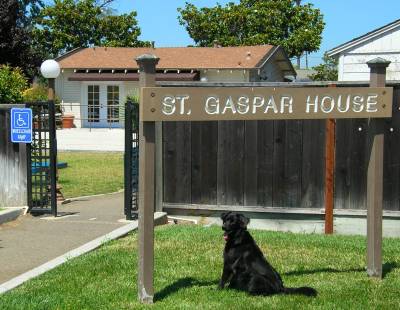
stgasparhouse.jpg Effective August 15, when I return from vacation, I will begin moving into my new office at St. Gaspar House. A new set of doors, visible in the picture have replaced the sliding glass doors. This will provide a bit more security, and will also enable me to enter from this side. Other groups will continue to use the large meeting room and the kitchen area of the house and will continue to use the front door. With this new door, I will not need to interupt their meetings to get to my office. Now I will be able to move my office out of my my bedroom, and I will have a place to meet prarishioners on a regular basis.

St. Gaspar House which is at the end of the property of the parish, was purchased may years ago. It was used as a meeting place and a service center for volunteer services. The house had not been well cared for in the past serveral years and it has collected a lot of junk that no one uses. So room by room we are going to begin to repair the house. It will become a place for Adult Faith Formation, for Spiritual Direction and for Marriage and Family Counseling as well as Administration. Catholic Charities provides a licensed Counselor on Fridays. The Legion of Mary meets there on a regular basis, and on Sunday it becomes a Sunday School for pre-school children. The School uses the large meeting room and the yard for retreats for various classrooms.

And finally, the Pastor has his own office. The principal, the School book keeper, the School Development office, the DRE, the Youth Minister, The Music Minister, the Maintenance Director, the Parish bookkeeper, all of these people have their own private office. Now the Pastor gets his own space. Currently my name is one of three on one of the small parlor doors.

Many thanks to Ken and Cruz who have worked long hours of repairing the walls and painting, and now will help assemble the desk and bookcases. When I am moved in, I will post a few pictures.

St.Gaspar House will also have its own website. This site will also replace the old Pacific Province site which was the home of all of St. Gaspar's letters. The new site for St. Gaspar's letters will be here once I get all the links moved over.

One the the new sets of Documents going into this new page is the book, The Life and Times of St. Gaspar del Bufalo by Giorgio Papasogli. This book was considered by Fr. Ray Cera, C.PP.S. to be the best "Life of Gaspar" available. Through the work of Fr. Milton Ballor this book is now availble in print and is a very valuable addition to any collection of the lives of the Saints. One of the things I like about it is the thorough explanation of the society, the culture and the politics of the early 19th century that forms the background of St. Gaspar's life and ministry. Another item the print version has that is not availble on the internet is the collection of pictures of the various places that were central in St. Gaspar's life.

The book is available for $20 plus shipping from Fr. Milton Ballor, C.PP.S., St. Charles Center, Carthagena, OH 45822. Parishioners of St. Edward or anybody here in the Bay Area can pick up a copy here at the Parish Office or St. Gaspar House when I move in.

Posted by Fr. Jeffrey Keyes, C.PP.S. at 2:56 PM | Comments (2) | TrackBack

July 21, 2006

Vacation Coming Again

I am just about through the mountain of mail that arrived on my last vacation. The second half of vacation is the first two weeks of August. I will spend my last weekend doing a Retrouvaille in Austin, but I have no idea where to go for the rest of it. I have a free flight to cash in, and a vacation allowance.

Anybody with any ideas?

Posted by Fr. Jeffrey Keyes, C.PP.S. at 2:33 PM | Comments (1) | TrackBack

July 20, 2006

Notes from Rome

I recieved a wonderful email from Rome from my friend Fr. Lopes:


Greetings from Rome. On Saturday, my mom and I head out to Umbria for a few days. We have the intention of going to the ā€œRefugio San Gaspareā€? for lunch or dinner. I’ll tell ā€˜em you sent me.

He promises to send pictures.

Posted by Fr. Jeffrey Keyes, C.PP.S. at 10:42 AM | Comments (1) | TrackBack

July 9, 2006

July 5, 2006

Experience the power of Christ's Blood

...says Pope Benedict.

The Pope requested pilgrims "to pray that modern humanity may experience the power of the Blood of Christ, poured out on the cross for our salvation."

Posted by Fr. Jeffrey Keyes, C.PP.S. at 4:16 PM | Comments (2) | TrackBack

Photos from the Colloquium

taken by yours truly.

Posted by Fr. Jeffrey Keyes, C.PP.S. at 1:58 PM | Comments (1) | TrackBack

July 3, 2006

July 1, 2006

John Paul II on the Blood of Christ

Evangelium Vitae 25

"The voice of your brother's blood is crying to me from the ground" (Gen 4:10). It is not only the voice of the blood of Abel, the first innocent man to be murdered, which cries to God, the source and defender of life. The blood of every other human being who has been killed since Abel is also a voice raised to the Lord. In an absolutely singular way, as the author of the Letter to the Hebrews reminds us, the voice of the blood of Christ, of whom Abel in his innocence is a prophetic figure, cries out to God: "You have come to Mount Zion and to the city of the living God ... to the mediator of a new covenant, and to the sprinkled blood that speaks more graciously than the blood of Abel" (12:22, 24).

It is the sprinkled blood. A symbol and prophetic sign of it had been the blood of the sacrifices of the Old Covenant, whereby God expressed his will to communicate his own life to men, purifying and consecrating them (cf. Ex 24:8; Lev 17:11). Now all of this is fulfilled and comes true in Christ: his is the sprinkled blood which redeems, purifies and saves; it is the blood of the Mediator of the New Covenant "poured out for many for the forgiveness of sins" (Mt 26:28). This blood, which flows from the pierced side of Christ on the Cross (cf. Jn 19:34), "speaks more graciously" than the blood of Abel; indeed, it expresses and requires a more radical "justice", and above all it implores mercy, 19 it makes intercession for the brethren before the Father (cf. Heb 7:25), and it is the source of perfect redemption and the gift of new life.

The blood of Christ, while it reveals the grandeur of the Father's love, shows how precious man is in God's eyes and how priceless the value of his life. The Apostle Peter reminds us of this: "You know that you were ransomed from the futile ways inherited from your fathers, not with perishable things such as silver or gold, but with the precious blood of Christ, like that of a lamb without blemish or spot" (1 Pt 1:18-19). Precisely by contemplating the precious blood of Christ, the sign of his self-giving love (cf. Jn 13:1), the believer learns to recognize and appreciate the almost divine dignity of every human being and can exclaim with ever renewed and grateful wonder: "How precious must man be in the eyes of the Creator, if he ?gained so great a Redeemer' (Exsultet of the Easter Vigil), and if God ?gave his only Son' in order that man ?should not perish but have eternal life' (cf. Jn 3:16)!". 20

Furthermore, Christ's blood reveals to man that his greatness, and therefore his vocation, consists in the sincere gift of self. Precisely because it is poured out as the gift of life, the blood of Christ is no longer a sign of death, of definitive separation from the brethren, but the instrument of a communion which is richness of life for all. Whoever in the Sacrament of the Eucharist drinks this blood and abides in Jesus (cf. Jn 6:56) is drawn into the dynamism of his love and gift of life, in order to bring to its fullness the original vocation to love which belongs to everyone (cf. Gen 1:27; 2:18-24).

It is from the blood of Christ that all draw the strength to commit themselves to promoting life. It is precisely this blood that is the most powerful source of hope, indeed it is the foundation of the absolute certitude that in God's plan life will be victorious. "And death shall be no more", exclaims the powerful voice which comes from the throne of God in the Heavenly Jerusalem (Rev 21:4). And Saint Paul assures us that the present victory over sin is a sign and anticipation of the definitive victory over death, when there "shall come to pass the saying that is written: ?Death is swallowed up in victory'. ?O death, where is your victory? O death, where is your sting?' " (1 Cor 15:54-55).

Posted by Fr. Jeffrey Keyes, C.PP.S. at 6:54 PM | Comments (0) | TrackBack

Letter 57

April 14, 1813
Countess Lucrezia Ginnasi
Imola

The grace and the love of our Lord Jesus Christ be always with us. Amen.

Esteemed Countess
I begin this letter at a time when the Church directs our attention to a most serious reflection on the august mysteries of our Redemption, Wednesday of Holy Week, (1) and she urges us to make fervent acts of love for Jesus, our total Good. Oh how our loving Mother Church, completely solicitous for us her children, compassionately makes every effort to etch into our souls this great truth which summarizes all the others: that is to say, that all of us belong to Jesus since he gave himself entirely to us! To speak of any other topics during these holy days would be an estrangement from those memories which are most efficacious in awakening in our hearts the most vivid sentiments of holy love, disposing us for the possession of that homeland which alone can make us completely happy.

Therefore, let us enter in spirit the sweetest Heart of Jesus, the burning furnace of love for mankind and, therein, let us briefly remind ourselves of all the aspects of that mystical fire, so that we can offer ourselves with completeness and greater perfection to the exercise of the Christian virtues, living for God alone.Ignem veni mittere in terram, et quid volo, nisi ut accendatur?(2) Prayer: "Sweet Heart of my Jesus, make me love you evermore.

There is no human language nor any sufficient number of volumes that can worthily describe all of the acts of love by which we have been enriched in our crucified Redeemer! Just to repeat one or the other would require the fervor of those fortunate souls who, like the eagle, freely soared upward from all the things of this miserable world to enjoy the delights of the nectar of Paradise. Certainly they, in some way, will be able to convince us of this delightful theme, but then, what can I do, a miserable sinner, whose heart, through my own fault, is colder than a stone and who does not know how to return love to the one who has loved me so much? Oh divine Holy Spirit, please help me so that I can, at least in a small way, give expression to those sentiments which are apt for arousing and moving us (3) to this holy exercise of love.

Oh soul, redeemed by the most precious Blood of Jesus the Redeemer, at this point, lift up your thoughts and realize that this ineffable benefit and august mystery, together with the Incarnation of the Son of God, was a flaming outburst of love: exinanivit semetipsum formam servi acciplens. (4) His submission to so many pains and trials was a flaming outburst of love, finally expiring in a sea of sorrows and on the infamous scaffold of Calvary. It was a flaming outburst of love to leave himself entirely in the Eucharistic banquet. It was a flaming outburst of love for him to find his delight in us miserable creatures: deliciae meae cum filiis hominum, (5)and that burning wish of his for our eternal salvation in the beloved homeland of heaven.

Oh soul, plunge yourself deeply into these moving thoughts and you cannot help but repeat with the Apostle: Caritas Christi urget nos! (6) It is not so much what Jesus suffered as it is the love that he demonstrated in his suffering for us that obliges us and even forces us to love him in return. Let us listen to what St. Francis de Sales says in this regard: "Knowing that Jesus, true God, has loved us to the point of suffering death for us, even death on a cross, is this not the same as having our hearts put under a winepress and feeling its crushing force, squeezing out love with a violence that is as gentle and loving as it is forceful?" Then he adds: "So then why do we not cast ourselves onto Jesus Crucified, to die on the Cross with him who was willing to die out of love for us? We ought to say: I shall cling to him and I shall never abandon him; I will die with him and I shall burn in the flames of his love. One and the same flame will consume this divine Creator and his miserable creature. My Jesus gives all to me and I give my all to him. I shall live and lie on his breast; neither death nor life will ever separate me from him. Oh eternal love, my soul seeks you and chooses you for all eternity. Come, Holy Spirit, inflame our hearts with your love. To love or to die; to die to every other love so as to live in the love of Jesus. Oh Savior of our souls, allow us to chant forever: Hail to Jesus; love Jesus; hail to Jesus whom I love; I love Jesus who lives forever and ever."

This love (says the Ven. John of Avila) is the kind that makes good souls go beyond themselves and leaves them in a state of amazement when they come to realize it. Then, a feeling of interior burning arises, a desire for martyrdom, a happiness in suffering, an enjoyment of those things that the world fears, and an embracing of those things that the world abhors. St. Ambrose says that the soul that is wedded to Jesus Christ on the Cross considers nothing more glorious than to bear in itself the marks of the Crucified. Oh how, my beloved, can I repay you for your love? He is deserving to have a compensation of blood for blood. See, here I am tinted with that blood and nailed to that Cross! Oh holy Cross, receive me unto thyself. Oh crown, loosen thyself so that I can place my head therein. Oh nails, release those innocent hands of my Lord and pierce my heart with compassion and love. ... Oh my most loving Lord, intoxicate our hearts with this wine, burn them with this flame, wound them with the arrows of your love.

Now, as a comfort to one who lives a moderated life it is necessary to be warned about a strong temptation by Lucifer who seeks to represent to us as a very defective thing something that, in reality, is only an effect of that divine love which dwells in the just. Let me explain. From the time that a soul surrenders itself sincerely to divine service and seeks to please its Beloved, it yearns for nothing else than a greater fervor, a greater holiness, a greater perfection. Then, the devil, with respect to this most holy desire which must be regulated in a practical way in keeping with the will of God, finds a way of causing it anguish, assailing it and making it fall (if he can succeed in this) into such a state of dejection that he does not allow it to find a moment of peace, either because of sins committed in the past or because of an excessive fear of falling into new sins, etc., and thus making every effort futile. It is impossible (the tempter of the soul keeps saying as he tries to reduce it to despair) to succeed in an undertaking which would require in you more virtue, more merits, more fervor. It is impossible for you to make progress in doing good, when, by your sins, you have lost the merits of the grace of the Almighty which are needed. In short, it is impossible to be able to fly without wings. Now, if the soul listens to such deceptive images, then the enemy will continue to question it as follows: Tell me, don't you really know how wretched you are, how deficient, how ungrateful before God? ... In your ingratitude, could you really feel worthy of the gentle kindnesses of his ineffable divine love? Therefore, lay aside any such thoughts, for otherwise you will be marked as a presumptuous and proud individual.

Oh how really subtle is that diabolical deception, for it is covered with a mantle of false humility that causes one to attribute to vice something that is happily produced by the love for God. Hence, let us open our eyes and, in order to elude every infernal deceit, let us etch into our hearts the following words of St. John Chrysostom, since they are most opportune in restoring to ourselves calm and tranquility of spirit: "When the love of God has taken possession of a soul, it produces in it an insatiable desire to act in behalf of the Loved One, so much so that, despite the many and the great acts that it performs for a long period of time spent in his service, all seems to be nothing and it always feels hurt that it does so little for God, and that if it were licit for it to die and be destroyed for him, it would be happy to do so. Thus it is that it always looks upon itself as useless in everything that it does because when love points out to it what God deserves, then in that clear light it sees all the defects of its own actions, bringing on confusion and pain from everything it does and recognizes as poor the deeds that it performs for so great a Lord."

St. Justinian says: "When one truly is making progress, he feels in himself a continuous desire to advance further, and as he grows more in perfection, so much more does the desire increase; for as the light in him continues to grow, it always seems to him that he has no virtue at all and that he is doing nothing good at all, and if he were to see himself doing something good, he gives himself no credit. Therefore, the situation is that he is continually working for the acquisition of perfection without ever growing tired". Hence, all the consequences of the love of God pointed out up to now are nothing but the products of that very same love. They never tend to render the soul inactive, but rather by their very nature excite it to greater industry and concern to purify itself before God. So, how truly terrifying is the devil when he seeks every imaginable way to impede the progress toward perfection, blocking one=s total dedication to God. Who is it that cannot recognize the iniquity and the origin of a temptation which tends to arrest the spirit in its chosen course of virtue? "A humility that disquiets one", says St. Teresa, "never comes from God but from the devil". In fact, God does not fail to help us in those trials since he is desirous of our love. Fili, praebe mihi cor tuum, ecce cor meum. (7)

Whatever artifice the devil uses in this regard, the soul must courageously remember what that great servant of God, Fr. Segneri, Sr., used to say to oppose the enemy and to achieve a most glorious victory over him: "There are two ways for clearing out a terrain that has become jungle and covered with heavy growth. One is to take an ax and begin cutting down trunk after trunk. The other is to attack it with fire; and this second way is without comparison, not only because it is easier but because it is more useful in the sense that the terrain is made more fertile by the foliage that is burned down. The same thing occurs in our souls. One can pursue the method of exercising various virtues, uprooting vice after vice, but this method demands great labor, lengthy time and results in little fruit. The real method is to attack the heart with a great fire of love for God and this, in a short time, will accomplish what otherwise would require much effort. Furthermore, it not only purges the soul but wondrously makes it productive". So, whatever may be the condition of the soul, it sees in itself its defects, it considers its status, it realizes how unworthy it is of heavenly favors and notes its ungratefulness towards God. Sorrowfully it applies itself to the exercise of that love that has been commanded to us by the words: Diliges Dominum Deum tuum ex corde. (8) It becomes purified and beautiful in the eyes of the Lord and marvelous prerogatives will continually grow within itself. This is the effective way of angering the devil and removing every obstacle to the working of the grace of Jesus who wants us as his own, because no one can serve him and the world, and because there can never be a union between light and darkness, between fire and water, between Christ and Belial.
Fr. Segneri, Jr. used to say that the love of God is a thief that easily despoils us of everything so that we can possess nothing other than God. St. Francis de Sales said that when a house catches fire, people will throw all the furniture out through the windows; when a person gives himself completely to God, he seeks to rid himself of everything that is earthly. In that way, one comes spiritually to the point of dying to anything that one has in this miserable world, thus verifying in ourselves the words: Beati mortui qui in Domino moriuntur. (9)

Not everyone is called by God to renounce temporal goods voluntarily or by vow: 'but, all must strive affectively for that end by releasing the heart from those annoying shackles and seeking only the faithful fulfillment of the divine will: Deus cordis mei; et pars mea Deus in aeternum. (10) The one who must dwell in the world must imitate Noah's dove, which pure and candid, unlike the raven, returned to the good Patriarch. Speaking apart from the figure, I mean to say that our souls must not depart from the mystic ark of the sweetest heart of Jesus; but, rather, should always remain there with its affective love as the only place where it can find peace and quiet.

With these holy thoughts, fervent souls are sanctified in that state of life in which the Lord has been pleased to place them and, with holy joy, they surrender themselves to be of help to their neighbors, to be of benefit to others and, in short, to carry out whatever is within their competency. In that way, one dwells in the world, to be sure, just like the three young men in the fiery furnace of Babylon, not being harmed at all by the mysterious flames that burn incessantly. Oh if only everyone understood these truths, how much more successfully would we pursue the goal for which we have been created, while recognizing ourselves as pilgrims on this earth and spend the days of our life with interior detachment from whatever is transitory! Dominus pars haereditatis meae et calicis mei, tu es qui restitues haereditatem meam mihi (11) (says the royal Prophet). ... Introduxit me in cellam vinariam, ordinavit in me caritatem. (12) (Cant. 2/4). This wine cellar, St. Teresa writes, is divine love which, when it takes possession of a heart, inebriates it with itself in such a way that it makes it forget everything that is created. A person who is drunk is, as it were, dead in his senses: he does not see nor hear nor speak. That is what happens to a soul that is inebriated with divine love, as it no longer has a sensation for things of this world and does not wish to think of anything else but God, to speak of anything but God, nor do anything else but love and please God.

The Lord said to St. Gertrude, who had asked him what he wished of her: "I wish nothing more from you than a heart devoid of all created things". The prayer of union (St. Teresa writes) it seems to me indeed to be nothing other than a dying as it were to all created things in this world so as to enjoy God alone. What is certain is that the more we turn away from creatures, detaching ourselves for the love of God, the more he will fill us with himself and the more closely united we will be with him. Deus meus et omnia. (13) St. Francis was wont to say: Oh my God, you are my all and my every good! What beautiful words those are: "My God and my all". Thomas a Kempis says that for one who understands this, nothing more need be said; and for one who loves, it is a sweet experience to repeat always: Deus meus et omnia. The aforementioned St. Francis de Sales would say: "If I ever came to discover in my heart a single fiber that was not God's, I would want to tear it out immediately".

Let us conclude then: we must be altogether God's, just as he gave himself entirely for us. "Oh how deceived (de Sales says) is the one who bases sanctity on something other than the love of the Lord. Some base sanctity (the Saint writes) on austerities, others on almsgiving, others on prayer, others on frequenting the sacraments. As for me, I know of no other perfection than that of loving God with all my heart. For, all the other virtues, without love, are only a pile of stones. If we do not enjoy perfectly this holy love, the defect lies in us since we fail to give ourselves entirely to God."

Here is how St. John of the Cross speaks allegorically on this subject: "It makes little difference whether a bird is bound with a heavy cord or with a very thin one; the bird will always remain bound and never be able to fly away". Let us apply these reflections to our own situations and let us reach the goal that we hope for.

Finally, the means for attaining perfect love are the following, taught to us by the angelic Doctor, St. Thomas: First, to have a continuous remembrance of the general and particular benefits received. Second, to think of the infinite goodness of God which is always ready to do good to us, to always love us, and to seek our love. Third, to diligently avoid even the least thing that is displeasing to him. Fourth, to renounce all earthly goods (not having an inordinate attachment to them). Fr. Taulero adds still another great means to the attainment of a perfect love of Jesus Christ, namely, meditation on his holy Passion.

So, Countess, let us continue spiritually to live always in the holy union of love at the foot of the Cross; there, reciprocally, let us implore divine mercy. Let us be concerned about our eternal salvation. Reflect often on the great desire that the Savior has to see that everyone is saved. Remove from your heart every worry and harmful fear. Serve the Almighty with joy of spirit, which I heartily urge you to do. Do not doubt that you will gain the incorruptible crown. Have a special remembrance of me, a miserable sinner who, by reason of the priesthood to which God has called me, stand in need of much spiritual help to faithfully correspond to it. Without adding anything further, I am
Your humble servant

P. S. You must be patient if these letters of mine do not arrive with regularity on the set days that we agreed upon, since it is necessary for us to adapt ourselves to the present circumstances. But, be absolutely convinced of my very deep and solid concern for this undertaking (even though I recognize what a weak instrument I am, ignorant and good for nothing). In practice, you will see how you will make progress prudently in working for the greater glory of God. Whenever I have a page to send to you, I will include it with the ones I send to Monsignor Annibale and, in that way, our letter correspondence will be kept known only to the Lord. Be happy, very happy, and again be assured that I am

Your humble servant


NOTES
(1) In 1813, Wednesday of Holy Week fell on April 14th. Therefore, we have assigned that date to this letter.
(2) I have come to cast fire on the earth, and what do I wish but that it be blazing?
(3) Some words were scratched out here.
(4) He emptied himself taking the form of a slave.
(5) My delights are with the children of men.
(6) The love of Christ urges us.
(7) Son, offer me your heart, behold my heart.
(8) You shall love the Lord your God with all your heart.
(9) Blessed are the dead who die in the Lord.
(10) God of my heart, and God is my part for eternity.
(11) The Lord is part of my inheritance and of my chalice; you it is who will restore my inheritance to me.
(12) He brought me into the wine cellar, and his intention toward me was love.
(13) My God and all.

Posted by Fr. Jeffrey Keyes, C.PP.S. at 3:50 PM | Comments (0) | TrackBack

Blood, Sacred Blood

This was article for Precious Blood Family Magazine and a repost from late 2003. It is basically my homage to St. Gaspar's letter 57

Blood is not pleasant to think about sometimes. Some become squeamish. At the same time, blood has a central place in some of our violent movies and other entertainment. There we do not pay attention to it. It is not real in the movies. Still, spend a few moments thinking about blood, your blood. Stop. Take your pulse. Blood is central. It is powerful. Its action, its force, what it carries, gives us life. It moves faster, we move faster. It fails, we fail. It is the silent, ever present essence of the power of life.

Our ancestors had a vastly simpler, maybe primitive approach to blood. It was simply where life met death and death met life. Fresh, warm, crimson blood was an offering, a sacrifice, a gift back to God, taking the substance of the life God had given and, giving it back, offering it all. We flinch when the priest passes among us on Easter morning scattering the water of the newly blessed font over the people. Can you imagine what it was like in the desert when inaugurating the covenant Moses took half of the blood of the bulls and splashed it on the people? This was before dry cleaning was even imagined. You were stained. It didn’t come out. It was an enduring mark of life. Life branded you, stained you, claimed you as belonging to a covenant with life itself. It was remarkably more than the privileges of membership, and you can’t leave home without it. This primitive approach developed through time to an elaborate ritual in the holy of holies where the blood of sacrifice was placed in the temple’s inner heart on the mercy seat. Blood was a way to communicate with God, to approach the very limits of life and death and receive in return his life and forgiveness.

St. Gaspar would invite us to this same reflection, but then would ask us to spend a few more moments reflecting on God’s blood, divine blood. His letters indicate it is too little to call this blood significant. Somehow our words do not convey its grandeur. This blood was the flaming outburst, the burning expression, the extravagant generosity, of a God of unreasonable and unimaginable kindness. (1) The human body of the Son of God becomes the holy of holies, and now the blood on the mercy seat is the blood rushing through his precious heart. His death on the cross and the tearing of the veil in the temple indicate that the presence of the divine has been snatched from a temple of stone and placed in the temple of a human heart where it is most defeated, overwhelmed or broken. We may think that God has abandoned us in our struggles; yet, in fact, he is closest to the broken and forsaken. You who once were far off have been made near through the Blood of Christ. (2)

This blood has a voice, a piercing cry. For Gaspar the sound of this blood extinguishes any noise of sin. (3) This voice cries out clearly on behalf of sinners and any who are broken. This voice cries to the heavens when life is lost or blood is shed. This is precisely where a devotion to or spirituality of the Precious Blood identifies us. Reciting a devotion is untruthful if it does not correspond to devoted living, and a spirituality is empty if it is not a way of life. A Spirituality of the Precious Blood drives us to follow that voice, to take it up as our own. St. Gaspar would plunge us into these mysteries, (4)bending to its gentle crushing force that urges us on to a courageous love, first for the ineffable love of God, and in the same beat of the heart, to a love for all people, especially those who are far off. Yes, blood can be messy, but it is sacred too.

NOTES
1. Letter 57
2. Eph. 2:13
3. Letter 52
4. Letter 57

Posted by Fr. Jeffrey Keyes, C.PP.S. at 3:39 PM | Comments (0) | TrackBack

from Don Marco again

Don Marco certainly has a way with words. I think he should have been a CPPS instead of an O. Cist. Or maybe he would be able to help me begin a refounding of the CPPS.

Posted by Fr. Jeffrey Keyes, C.PP.S. at 3:21 PM | Comments (2) | TrackBack

On the Precious Blood

Required reading for the month of July.

Posted by Fr. Jeffrey Keyes, C.PP.S. at 1:22 PM | Comments (4) | TrackBack